
How to Select a Depth Sounding Transducer for a Bait Boat?[Dayu Electronics]
How to select a depth sounding transducer for a bait boat?
In the operating system of a bait boat, the depth sounding function is crucial. It can accurately detect underwater terrain, fish distribution, and water depth information, providing key data support for efficient and precise bait casting. The core component that implements this function is the ultrasonic transducer. Its performance directly determines the accuracy, stability, and reliability of the depth sounding data. To choose the right ultrasonic transducer, the following key factors should be comprehensively considered:
1. Operating frequency of the transducer:
High-frequency transducers (e.g., 200 kHz or higher): Short wavelength, higher resolution, suitable for fine detection in shallow water areas (generally less than 50 meters). However, high-frequency signals attenuate quickly in water and have limited penetration.
Low-frequency transducers (e.g., 50 kHz or 83 kHz): Long wavelength, strong penetration, can effectively detect deeper waters (up to several hundred meters), and have stronger resistance to turbid water interference. However, their resolution is relatively lower.
Selection suggestion: Bait boats primarily operate in inland waters such as nearshore areas, lakes, and reservoirs, where water depth is usually in the medium to shallow range. It is recommended to prioritize transducers with frequencies around 150 kHz to 200 kHz, which can provide better bottom contour and fish school resolution while ensuring sufficient detection depth (usually meeting 20-50 meter requirements), enabling precise bait casting positioning.
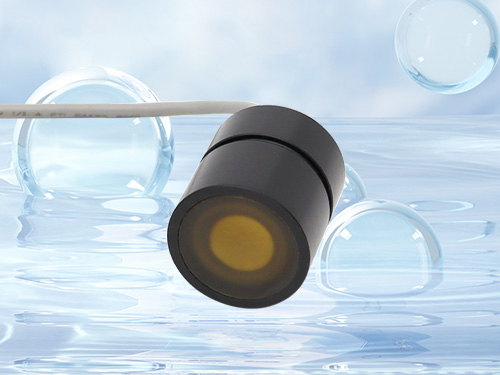
The DYW-150-E produced by Fuzhou Dayu Electronics is a transducer model that has been used for a long time on bait boats to measure water depth.
2. Beam angle of the transducer:
Narrow beam angle (e.g., 10°-15°): Concentrated energy, strong directional detection, high pointing accuracy, can obtain clearer and more detailed underwater cross-section images, particularly suitable for precise positioning of underwater structures (such as steep ledges and gullies).
Wide beam angle (e.g., 45° or above): Wide coverage, large single-scan area, high search efficiency, less likely to lose targets due to boat movement, but target detail and resolution may decrease.
Selection suggestion: For bait boats that require precise bait placement, it is recommended to choose a medium-narrow beam angle (e.g., 15°-25°). This ensures a certain level of detection accuracy to identify ideal bait casting points (such as flat bottom, edges of aquatic vegetation), while also providing a certain scanning width to improve efficiency in finding spots.
3. Transmit power and receiving sensitivity:
Sufficient transmit power ensures that sound waves can effectively reach the bottom and return; high receiving sensitivity can capture weak echo signals, which is especially important in deep or turbid water.
When selecting, it is necessary to ensure compatibility with the bait boat's depth sounder main unit. Choose transducer models that match the main unit's recommended parameters or are listed in its compatibility list.
Fuzhou Dayu Electronic Technology Co., Ltd. has been specializing in ultrasonic transducers for 17 years. If you are also troubled by how to select the right transducer for your bait boat, feel free to contact us, and we will provide you with precise one-on-one selection guidance.