
Urban Sewage Pipeline Flow Monitoring [Dayu Electronics]
Beneath the cities where we live, there are numerous drainage pipes within the underground pipeline network. These include stormwater drainage pipes, sewage drainage pipes, and domestic wastewater pipes. So what are their functions?
Stormwater drainage pipes: primarily help drain rainwater from cities, preventing severe urban flooding that could block our main traffic routes and disrupt people's daily lives and travel. If severe urban flooding occurs, it can endanger the safety of ordinary citizens and cause property damage. Therefore, monitoring the water level and flow in stormwater drainage pipes is crucial. We transmit measurement data from each key monitoring point in real time to the management department, enabling managers to effectively monitor the water level and flow conditions in urban stormwater pipes, safeguarding our city's safety.
Sewage drainage pipes: This mainly refers to the sewage discharge pipelines of industrial parks and enterprises. To effectively manage the water quality of urban inland rivers, control the volume of industrial wastewater discharge, and ensure that wastewater meets discharge standards, environmental protection departments conduct rigorous monitoring. Currently, sewage discharge monitoring integrates various water quality sensors, water level sensors, and flow sensors for effective measurement, reducing pollution of harmful substances in urban inland rivers and streams, and ensuring water quality safety for downstream farmland irrigation.
Domestic wastewater pipes: This refers to the discharge of domestic cleaning wastewater from residential communities, urban commercial areas, schools, and various government institutions. Biological wastewater must undergo effective treatment in a sewage treatment system before it can be discharged into rivers. If untreated domestic wastewater is discharged directly into rivers, it will cause great harm to our environment, mainly leading to the death of fish and algae, resulting in ecological imbalance. In addition, wastewater contains pathogens such as parasite eggs and enteroviruses that can spread diseases such as cholera and typhoid fever. Direct contact or consumption may cause digestive and respiratory system diseases, posing serious threats to our health and increasing the burden on the healthcare system. Therefore, monitoring the flow of domestic wastewater is also of vital importance.
When monitoring domestic wastewater pipes, the following characteristics are observed:
1. Intermittent discharge with regular patterns, closely related to people's daily routines;
2. Wide discharge area, linked to the extensive modern urban construction zones;
3. Large wastewater discharge volume, as the demand for domestic water increases with the improvement of people's living standards.
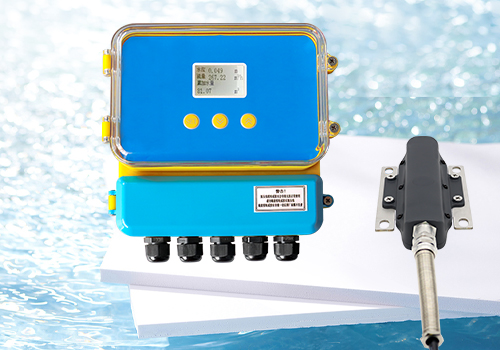
In summary, flow monitoring in sewage pipes is crucial. However, during sewage pipe flow monitoring, most sewage pipes are in a partially filled state. Moreover, stormwater pipes often contain significant sediment buildup, and sewage pipes frequently contain debris, greatly increasing the difficulty of monitoring discharge flow. What product should we choose for water level and flow sensors in partially filled pipes? To accurately measure the water level and flow in sewage pipes, we choose a contact-type ultrasonic Doppler flowmeter.
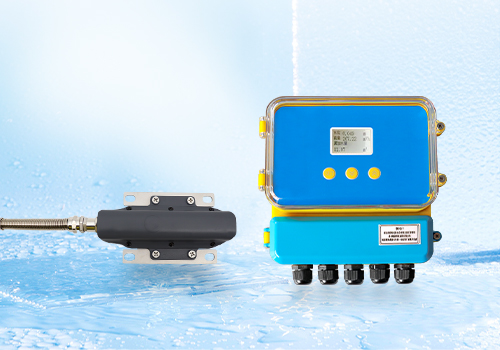
Product measurement principle: Ultrasonic Doppler Flowmeter measurement is based on the Doppler effect. The probe emits an ultrasonic beam at an upward (or forward) angle. As the ultrasound propagates through the fluid, bubbles or particles (impurities) in the fluid (which can be assumed to move at the same velocity as the water flow) cause a Doppler shift Δf in the reflected ultrasonic signal, and this Doppler shift Δf is proportional to the flow velocity. By measuring the Doppler shift Δf, the flow velocity can be determined. The Doppler velocimeter incorporates a pressure-type water level sensor that derives the water level from the differential pressure between water and atmosphere. Additionally, an ultrasonic water level measurement principle is used as an auxiliary level measurement to prevent the situation where the pressure sensor becomes clogged and the water level cannot be measured properly.
Product installation principle:
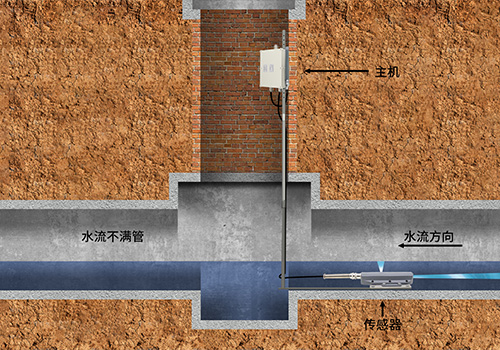
The main feature of the low-water-level compact velocimeter is that the sensor has an elevation angle of 0°, meaning the sensor transmits ultrasound horizontally. The sensor itself is approximately 38 mm in height, and it is recommended for use in applications with water levels above 50 mm. It is also essential to ensure at least 2 m of straight unobstructed pipe upstream of the sensor, with no obstacles that could cause turbulence or block the acoustic signal (the channel should ideally follow the "10 diameters upstream, 5 diameters downstream" rule; for example, for a pipe diameter of DN200, reserve 2 m of straight pipe upstream and 1 m downstream).
Installation schematic of the low-water-level ultrasonic Doppler velocimeter
Product installation site photo (manhole-type Doppler flowmeter):
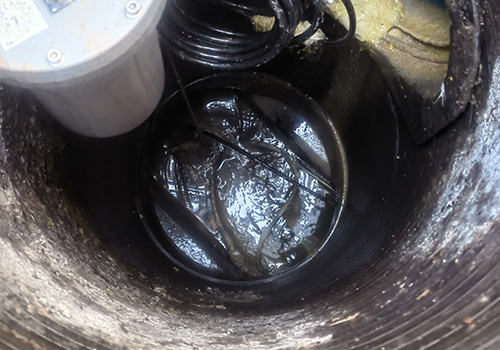
As shown in the figure above, the ultrasonic Doppler velocimeter is installed inside the pipe, with the sensor extending into the pipe opening, while the flowmeter's power supply, data acquisition, and transmission components are placed at the manhole access point.
The Doppler velocimeter is installed facing the incoming flow and fixed horizontally with the pipe.
However, during flowmeter operation, regular maintenance of the sensor is required. The velocimeter may have its flow sensor obscured by debris in the sewage pipe, and the pressure-type water level sensor may be blocked by silt commonly found in sewage pipes.