
Choosing the Right Frequency for Dayu Ultrasonic Anemometer Transducers Is Key to Accurate and Stable Measurements
The core performance of an ultrasonic anemometer largely depends on the operating frequency of its transducers. Choosing the right frequency is key to ensuring accurate and stable measurements.
Frequency selection is not simply about going higher or lower; rather, it requires finding the optimal balance across multiple factors:
High-frequency advantages (e.g., 300 kHz): shorter wavelength, better directivity, higher measurement accuracy, and more compact device size.
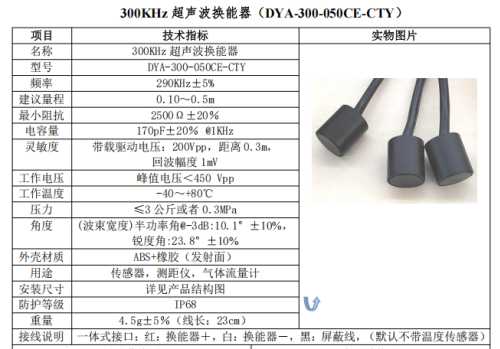
Low-frequency advantages (e.g., 125 kHz): longer wavelength, lower propagation loss, stronger anti-interference capability, and more stable performance in harsh weather such as rain and fog.
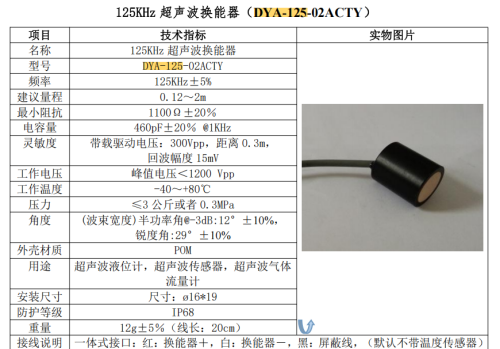
Therefore, frequency selection requires comprehensive consideration:
1. Measurement accuracy and size: For stringent requirements on accuracy and size, higher frequencies can be selected.
2. Environmental adaptability: Under complex meteorological conditions, medium and low frequencies prove more reliable.
3. Power consumption and cost: Frequency is closely related to power consumption and cost, so trade-offs must be made based on actual application scenarios.
Fuzhou Dayu Electronics, with 18 years of expertise in ultrasonic transducer production, offers a wide range of frequency options for our ultrasonic transducers. We can also customize and optimize them according to your specific applications, helping you find the perfect balance among accuracy, environmental adaptability, and cost, and laying a solid and reliable foundation for your wind speed and direction measurement system.