
Dayu Electronics Portable Doppler Flowmeter Applied to Flow Monitoring in Municipal Drainage Pipe Networks
Application of Portable Doppler Flowmeter in Flow Monitoring of DN300 Culvert Pipe
I. Project Background
1. Site Overview
In a municipal drainage pipe network renovation project, a DN300 (300 mm diameter) concrete culvert pipe located in a suburban area is involved. This pipe is mainly responsible for conveying rainwater and a small amount of sewage from the surrounding mountainous areas and residential areas to the downstream treatment plant. Since the culvert has been underground for a long time and some sections are located below the river channel, the internal flow conditions are complex, with not only clear water but also suspended solids.
2. Pain Points Faced
Engineering technicians need to obtain real-time flow velocity and flow rate data of the pipe to assess drainage capacity. However, the site faces the following challenges:
Partial full-pipe flow: The pipe is not in a full-flow state, and the water level fluctuates greatly with rainfall, making traditional electromagnetic flowmeters (which require full-pipe flow) impossible to install.
Temporary monitoring: There are no conditions for cutting into the pipe to install a fixed flowmeter. A device that is quick to deploy, accurate in measurement, and can be retrieved at any time is needed.
II. Solution
After comparative selection, the technical team decided to use the Fuzhou Dayu portable Doppler flowmeter for on-site measurement.
1. Selection Basis
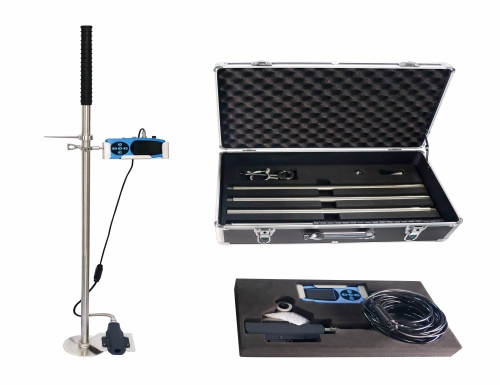
Portable measurement: The main unit is compact, and the sensor can be directly lowered into the pipe via an extension rod or installed on the wall, requiring no complex construction.
High integration: Modern portable Doppler flowmeters typically integrate a flow velocity sensor, a pressure-type level sensor, and a temperature sensor, allowing direct measurement of flow velocity and water level, with automatic calculation of flow rate through built-in algorithms.
III. On-Site Implementation Process
1. Measurement Point Selection
Measurement was carried out at an inspection well of the culvert pipe. This section of the pipe is straight, with relatively stable water flow, no turbulence or backflow, meeting the standard requirements for flow measurement.
2. Equipment Installation
Operation: The sensor part of the portable Doppler flowmeter was connected to the measuring rod and slowly lowered to the bottom of the DN300 pipe. Ensure that the sensor probe faces the direction of incoming flow and that the installation position is stable to prevent displacement by water flow.
Connection: The sensor was connected to the handheld main unit via a waterproof cable, displaying data in real time.
3. Parameter Setting
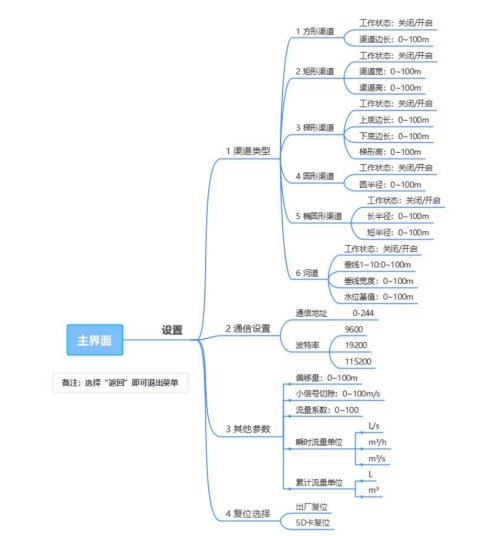
Based on site conditions, the following parameters were entered into the main unit:
IV. Application Conclusion
This monitoring task of the DN300 culvert pipe using the portable Doppler flowmeter was successfully completed, demonstrating the significant advantages of this solution under such working conditions:
Accuracy and efficiency: It successfully overcame the measurement difficulties caused by partial full-pipe flow and sediment-laden water, providing accurate flow velocity and flow rate data, and offering a reliable basis for drainage network model calibration.
Flexibility and convenience: No pipe cutting or flow diversion is required. Deployment can be completed within 10 minutes using an inspection well, greatly reducing construction costs and safety risks.
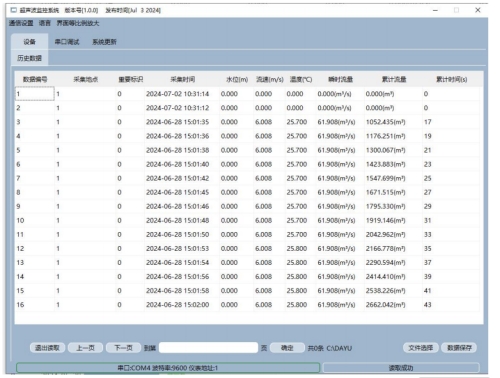
Data reading and export: After clicking "Read Data," the test data can be viewed, and a save path can be selected to store the data as a TXT file.
Summary:
The portable Doppler flowmeter is an ideal tool for temporary flow measurement in culverts, underground channels, and similar structures larger than DN200. Especially in complex sewage pipe networks or rainwater culverts, its strong anti-interference capability and flexible installation make it an indispensable detection device for municipal drainage departments and engineering inspection units.