
Pipeline Doppler Flowmeter Selection Guide: Key Strategies for Precise Adaptation to Complex Scenarios [Dayu Electronics]
The selection of a pipeline Doppler flowmeter should revolve around four core dimensions: fluid characteristics, measurement accuracy, environmental adaptability, and system integration, ensuring stable and reliable operation in complex scenarios.
Fluid characteristics are the foundation of selection. Doppler flowmeters rely on reflected signals from suspended solids or bubbles in the fluid. If the fluid is clean water with low suspended solids, an electromagnetic flowmeter should be prioritized; if it is sludge-laden wastewater or mud, the suspended solids concentration must be confirmed to be ≤20 kg/m³ to avoid signal attenuation leading to measurement failure. For example, in mining area sludge-laden wastewater monitoring, Doppler flowmeters use the transit-time method to adapt to high-suspended-solid fluids.
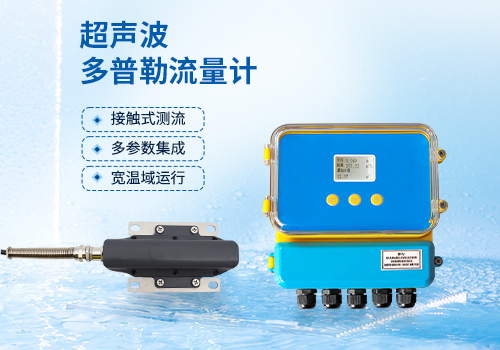
Measurement accuracy must match application requirements. Industrial drainage monitoring typically requires accuracy of ±1%, while agricultural irrigation can be relaxed to ±2%. Repeatability (consistency of multiple measurements under the same conditions) and linearity (the linear relationship between output signal and flow velocity) directly affect data reliability. For example, a flowmeter using frequency-domain Doppler analysis algorithms achieves a flow velocity resolution of 0.001 m/s, suitable for scenarios with stringent accuracy requirements.
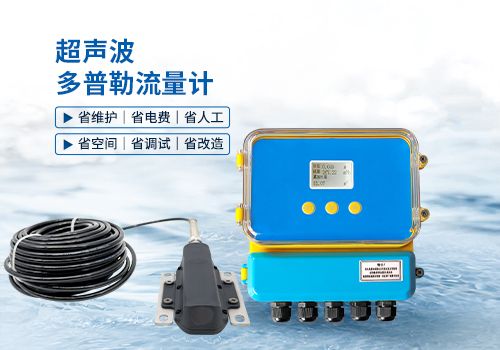
Environmental adaptability determines equipment lifespan. High-temperature, high-pressure, or corrosive environments require equipment with a protection rating of ≥IP68. For example, in deep-sea pipeline monitoring, models with pressure resistance of 100 bar and operating temperature of -40℃ to 120℃ are required; in chemical park wastewater outlets, PVDF plastic housings effectively resist chemical corrosion.
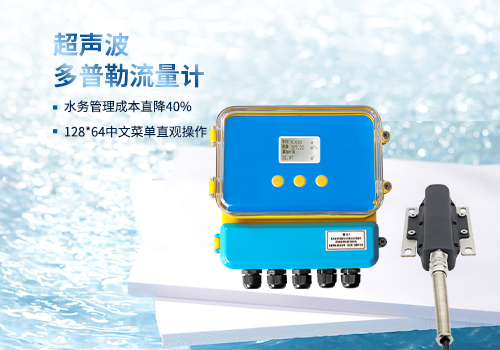
System integration should consider scalability. Prioritize devices that support RS485/Modbus-RTU protocols and 4G/NB-IoT wireless transmission for easy integration with existing monitoring systems. For example, a certain flowmeter model uses LoRa low-power transmission, achieving over 2 years of battery life on a single charge, reducing long-term maintenance costs.