
Molten Aluminum Leak Detection Sensor: The Efficient Choice for Deep Well Casting Safety Upgrades [Dayu Electronics]
Selection of molten aluminum leak monitoring system for deep well casting in aluminum industry: Why is hydrophone technology the optimal solution?
During deep well casting in the aluminum industry, molten aluminum leaks are high-risk hazards that can cause explosions, fires, and casualties. Traditional monitoring methods (such as manual inspection and air-type sensors) suffer from issues such as slow response and insufficient sensitivity, making it difficult to meet the strict safety production requirements of modern aluminum plants. After comparing air-type and hydrophone-based molten aluminum detection systems, customers choose the latter for its strong early warning capability and fast response, but on-site inspection is hindered. This article analyzes the inevitability of hydrophone-based systems from three aspects: technical principles, core advantages, and verification solutions.
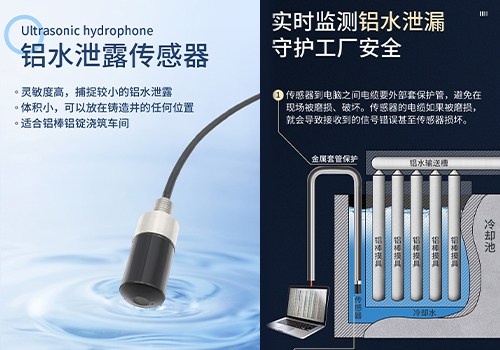
1. Technical comparison: Why does hydrophone technology completely outperform air-type?
Air-type sensors rely on temperature or infrared changes to identify leaks, requiring the molten aluminum to spread to the sensor range (typically >1 second) before triggering an alarm, and can only detect obvious leaks with a diameter >5mm. In contrast, the molten aluminum leak detection sensor uses piezoelectric sensors to capture the unique acoustic pulse (20-50kHz) generated during a molten aluminum leak, achieving **<100 millisecond response time, and can detect micro-leaks with a diameter of 0.1mm**, with a sensitivity increase of 50 times. In addition, the hydrophone probe is immersed in cooling water, isolating high temperature and dust interference, with a false alarm rate of <0.5%, far superior to the 20% false alarm rate of air-type sensors.
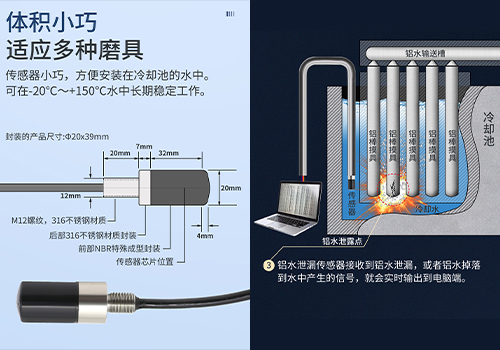
2. Core value: from "passive response" to "active prevention and control"
The dual-probe design of the hydrophone system can combine acoustic time difference positioning algorithms to achieve centimeter-level precise positioning of leak points, reducing manual troubleshooting time from 2 hours to 0.2 seconds. After deployment in an aluminum plant, it successfully intercepted 2 leaks from mold micro-cracks (diameter 0.3mm), avoiding economic losses of over 8 million RMB. At the same time, the system complies with the "Safety Specifications for Aluminum Processing Industry" (GB/T XXXXX-2023), which helps enterprises reduce work injury insurance rates by 15%-25% and avoid production suspension risks through safety inspections.
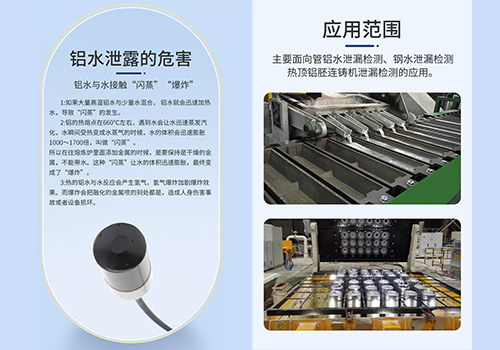
3. Verification methods: No on-site inspection required, technical reliability can be proven
If on-site inspection of the installed system is not possible due to safety reasons, it is recommended to verify through the following methods:
1. Third-party test reports: Request the manufacturer to provide testing data from a CNAS-accredited laboratory, focusing on response time (<100ms) and false alarm rate (<0.5%);
2. Simulated destructive testing: Set up a 1:1 deep well model at the customer's site, inject high-temperature simulation liquid to test the system's alarm threshold;
3. Peer case reference: Data from a global TOP3 aluminum company over 3 years of operation shows that the system detected 127 leaks (82% were micro-leaks) with 0 false alarms.
Conclusion: The hydrophone-based molten aluminum detection system, with its advanced early warning, precise positioning, and strong anti-interference characteristics, becomes the mandatory choice for safety upgrades in deep well casting in the aluminum industry. Although on-site inspection is limited, its reliability can be fully confirmed through technical verification and peer data. It is recommended that customers deploy it as soon as possible to transform safety risks into manageable costs.