
Ultrasonic Doppler Flowmeter Flow Measurement Case Study [Dayu Electronics]
For reservoir discharge flow projects measuring water level, flow velocity, and flow rate, options include time-difference method open-channel flow meters, radar flow meters, and ultrasonic Doppler flow meters. If higher accuracy is required, choose ultrasonic time-difference open-channel flow meters and Doppler flow meters with higher flow accuracy.
Measuring principle of ultrasonic Doppler velocity meter: The ultrasonic Doppler velocity meter measures based on the Doppler effect. The probe emits an ultrasonic beam obliquely upward (or forward). As the ultrasound propagates through the fluid, which contains bubbles, particles, or other impurities (the impurities can be assumed to move at the same velocity as the water), when the ultrasound encounters these impurities, the reflected ultrasound undergoes a Doppler frequency shift Δf, which is proportional to the flow velocity. By measuring the Doppler frequency shift Δf, the fluid velocity can be determined.
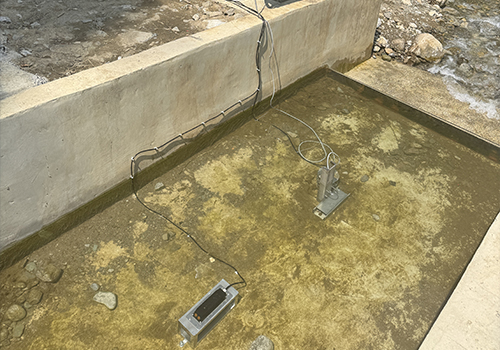
Product features: Uses ultrasound to measure flow velocity with the measurement point ahead of the probe, without disturbing the flow field. It offers high measurement accuracy, wide range, capability to measure both weak and strong currents, high resolution, and fast response. It also integrates pressure and temperature sensors for measuring water depth and temperature, and transmits velocity, water level, and temperature via RS485.
Now let's look at installation photos sent from the customer's site to identify the cause of inaccurate data.
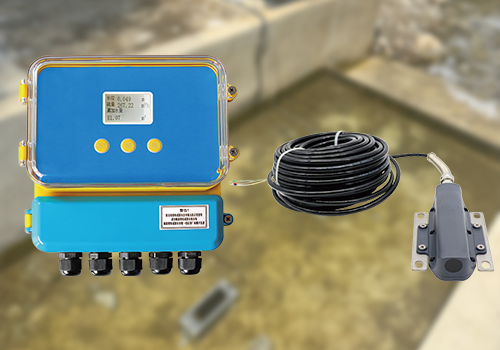
Installation overview:
1. The Doppler velocity meter is installed in the center of a rectangular channel, about 2 meters from the outlet, with a channel width not exceeding 3 meters.
2. The installation height is approximately 5 cm, supported by a stainless steel base.
3. The customer reported intermittent flow velocity readings and unstable measurement data.
Analysis of inaccurate measurements:
1. Too close to the outlet: The outlet is blocked by a metal baffle, creating a dead water zone in front of the outlet where there is essentially no flow.
2. Even though the Doppler velocity meter is installed about 2 meters directly in front of the outlet, its installation height is approximately 5 cm, which is lower than the height of the metal baffle. Therefore, when water flows, the water at the installation point may still have no velocity, so the flow velocity cannot be measured.
Recommendations for modification:
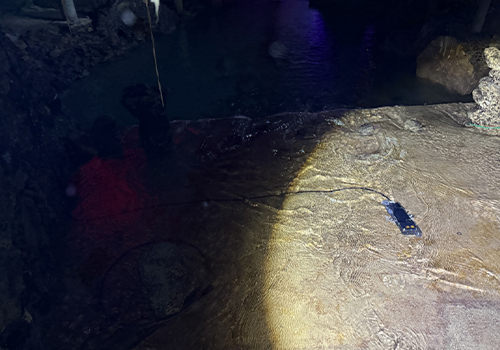
1. Move the Doppler velocity meter installation position further forward, ensuring straight channel sections of at least 10 times the channel width upstream and 5 times downstream. If the site cannot provide sufficient straight channel length, choose a location where the water flow is smooth and steady.
2. If there is no upstream straight channel, lower the downstream baffle to below the installation point of the Doppler velocity meter, ensuring smooth water flow at the installation location and preventing the formation of dead zones.
3. After lowering the installation, clear the rocks directly upstream inside the channel. Ideally, there should be no obstructions on the flow path that could affect normal velocity measurement.