
Wood Panel Bulge Detection Sensor Applied for Bulge Monitoring in a Factory[Dayu Electronics]
1 Project Background
In Anhui Province, Mr. Zhang operates a factory specializing in the production of composite panel materials. Recently, he came to consult with a new problem, hoping to try a brand-new process. This process has extremely high requirements for the quality of the composite panels; there must not be any bulge of even one millimeter inside. To ensure quality, Mr. Zhang plans to install a detection equipment system on the production line. The core of this equipment is a conveyor belt, with sensors installed above and below the belt. These sensors work through probes, where one probe transmits signals and the other receives signals, in order to detect whether there are any bulges inside the composite panels.
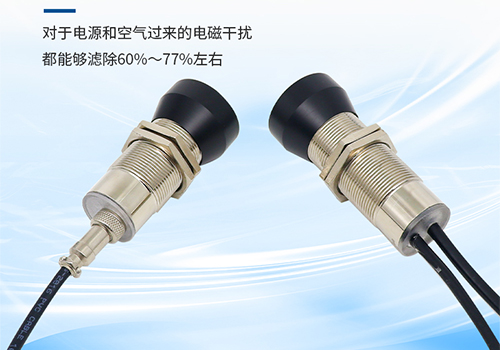
The composite panel samples brought by Mr. Zhang are quite substantial in size, with a length of 5 meters, a width of 1.6 meters, and a height of 350 millimeters. These composite panel materials also contain foam, which makes the detection
2 Challenges and Pain Points
High-Precision Detection Requirements
The accuracy of bulge detection needs to be controlled within 1mm, and traditional contact-based measurement methods are difficult to meet this requirement. The foam material may also cause attenuation of ultrasonic signals, affecting detection stability.
Full Coverage of Large-Sized Panels
The wood panels are up to 1.6m wide, so it is necessary to ensure that the sensors cover the entire width to avoid missed detection.
Environmental Interference and Signal Processing
The factory environment may have vibrations, dust, and other factors that affect sensor signals.
3 Solution
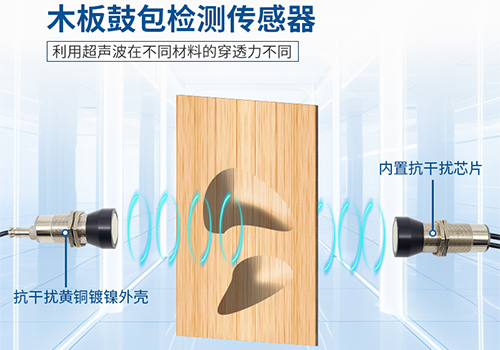
Ultrasonic through-transmission detection (a pair of sensors facing each other) can be used. By analyzing the propagation time of ultrasonic waves in the panel and the changes in signal strength, the position of bulges can be identified (non-contact, high precision up to 0.5mm, suitable for foam materials).
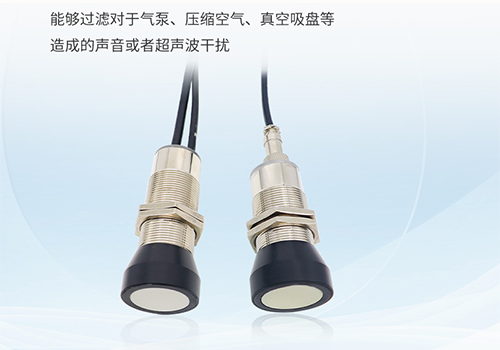
Currently, the wood panel bulge sensor cannot measure this because the middle layer is foam material, which absorbs ultrasonic waves significantly, so normal measurement is not possible at present.