
Doppler Flowmeter Applicable Conditions and Features [Dayu Electronics]
Doppler flowmeter is based on the acoustic Doppler effect, calculating flow velocity and flow rate by measuring the frequency shift of ultrasonic waves reflected by suspended particles or bubbles in the fluid. It is suitable for complex conditions involving two-phase fluids containing sediment, aquatic plants, and bubbles. Its technical features include a wide flow velocity measurement range of 0.03-5m/s, flow velocity accuracy of ±1%±0.01m/s, water depth measurement capability of 0.02-10m, and an IP68 protection rating, enabling stable operation in extreme environments from -20℃ to 60℃.
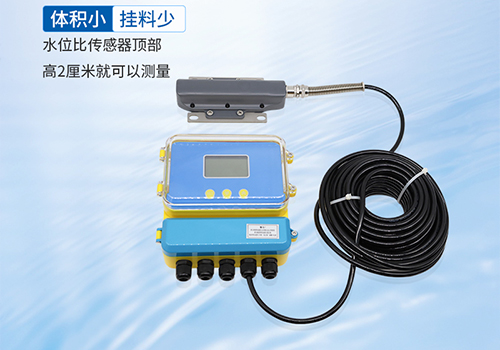
The device adopts non-contact in-situ installation, requiring no pipe cutting or channel modification, and supports various scenarios such as full pipes, partially filled pipes, and open channels. In irrigation district channel monitoring, single-point or multi-point flow velocity collection combined with cross-sectional integration enables accurate calculation of flow in wide channels; in municipal drainage pipe networks, it can simultaneously monitor water level, instantaneous flow, and cumulative flow, achieving real-time warning of abnormal conditions such as sedimentation and overload.
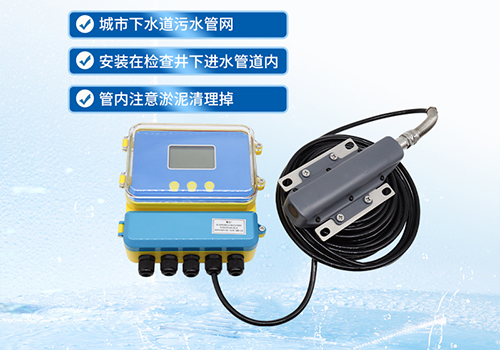
Technical advantages are reflected in anti-interference capability and data stability: the built-in temperature sensor corrects the influence of water temperature fluctuations on sound speed, the information window reflected wave superposition averaging algorithm reduces signal crosstalk, and the 46mm spacing transducer design improves measurement reliability. The device supports RS485, 4G wireless transmission, and Modbus protocol, compatible with remote monitoring and data analysis requirements, suitable for smart water conservancy, environmental monitoring, and industrial process control fields.