
Vertical TBM Ranging Ring Sensor: Monitor Deviation and Adjust Verticality [Dayu Electronics]
Application Scheme and Recommendations for the Ranging Transducer in Vertical TBM Shaft Construction
During vertical TBM shaft construction, accurately monitoring the verticality of the TBM is critical to ensuring project quality and construction safety. The customer plans to install sensors on the ranging ring above the vertical TBM to confirm in real time whether the TBM is deviating, thereby promptly adjusting its verticality, effectively preventing the TBM from drifting off course, and ensuring that the shaft construction proceeds precisely along the predetermined trajectory.
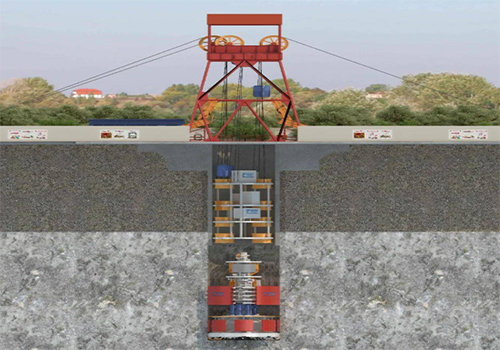
The target depth for this TBM construction is approximately 1,000 meters, and the construction environment is extremely complex and demanding. The slurry environment inside the shaft exhibits unique characteristics, with a sediment content as high as 1.15 KG/L and a considerable amount of rock. This special environment poses a severe challenge to the performance of the ranging transducer. The customer explicitly requires a transducer capable of withstanding a pressure of 12 MPa to ensure stable and reliable operation in the high-pressure slurry environment.
In terms of measurement requirements, the customer expects the ranging transducer to accurately measure the shaft wall distance of 2.6 meters to 3 meters. However, based on our current technical experience, we have not yet encountered such a complex and demanding TBM construction ranging scenario. Our existing pile foundation inspection transducers, when used in borehole inspection instruments within a bentonite density of 1.3 KG/L, can achieve a measurement distance of 2 to 2.5 meters. Nevertheless, given the significant differences between this construction environment and measurement requirements and those previously encountered, it is impossible to directly determine whether the existing transducers can fully meet the customer's requirements; actual testing is necessary to verify their performance.
Considering the current shortage of technical staffing in our R&D department, it is difficult to invest substantial effort in a short time to develop targeted circuits and algorithms. At the same time, the project timeline is tight, and pressure from time constraints is considerable. To ensure the smooth progress of the project, we recommend that the customer design the circuits and algorithms themselves. With their in-depth understanding of the project requirements and professional technical capabilities, they can design circuits and algorithms that better suit the actual construction conditions, thereby fully leveraging the transducer's performance potential.
Once the customer has completed the circuit and algorithm design, they can select our existing pile foundation inspection transducer for testing. Through actual testing, it will be possible to directly assess whether key indicators such as measurement accuracy, stability, and pressure resistance of the transducer in the complex slurry environment meet the project requirements. If the test results meet expectations, the project can proceed smoothly; if shortcomings are identified during testing, both parties can discuss optimization solutions based on the test data, making timely adjustments and improvements to ultimately satisfy the ranging needs of vertical TBM shaft construction.
We look forward to collaborating with the customer, through rigorous testing and optimization, to provide a reliable ranging solution for vertical TBM shaft construction and ensure the high-quality completion of the project.