
Locating Leak Points with Dual Hydrophone Ranging? Full Guide on Principles and Key Points[Dayu Electronics]
Analysis of dual hydrophone ranging technology for leak point localization
1. Technical principles and implementation methods
1. Core principle
Two hydrophones receive acoustic signals generated by the leak point, and the time difference of arrival (TDOA) method is used to calculate the leak point location. Specific steps are as follows:
? Acoustic wave propagation model: The acoustic wave generated at the leak point propagates outward in the form of spherical waves, resulting in a difference in arrival time at the two hydrophones.
? Time difference calculation: Record the time difference (Δt) of the acoustic wave arriving at the two hydrophones, combine it with the sound speed (v) and the known hydrophone spacing (d), and solve for the leak point coordinates through geometric relationships.
2. Implementation steps
? Hydrophone placement:
? Spacing recommendation: 5-10 meters (adjusted based on pipe diameter and acoustic attenuation).
? Position requirements: Symmetrically arranged on both sides or upstream/downstream of the pipeline, ensuring unobstructed sound reception paths.
? Signal acquisition:
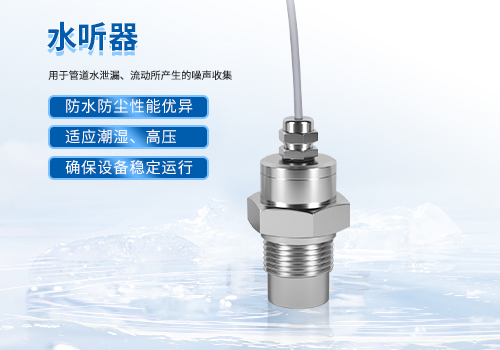
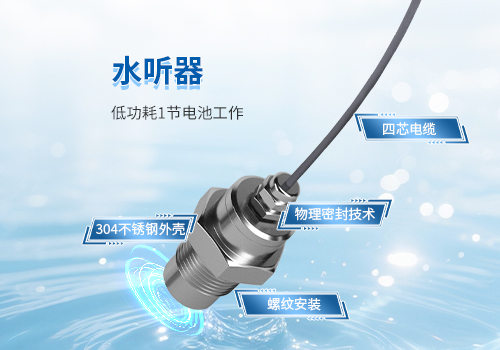
? Use high-sensitivity hydrophones (frequency response range: 10Hz-10kHz) with a sampling rate ≥100kHz.
? Synchronously acquire acoustic signals from both hydrophones to ensure a consistent time base.
? Time difference extraction:
? Use cross-correlation algorithms to calculate the time difference between the two signals, eliminating noise interference.
? Example: If Δt=0.001s and sound speed v=1500m/s, then the distance difference between the leak point and the two hydrophones is 1.5 meters.
? Position calculation:
? Convert the time difference into a distance difference, then combine it with the hydrophone coordinates to solve for the leak point location using geometric or least squares methods.
2. Technical advantages and limitations
1. Advantages
? Trenchless detection: No need to damage the pipeline, suitable for complex underground environments.
? Real-time localization: Leak points can be monitored in real time, more efficient than traditional acoustic listening methods.
? Controllable cost: Equipment cost is lower than distributed fiber optic sensing systems, suitable for small to medium-sized pipelines.
2. Limitations
? Sound speed dependence: Sound speed is affected by water temperature and water quality, requiring regular calibration (error approximately ±1%).
? Environmental interference: Background noise (e.g., traffic, industrial) can reduce time difference extraction accuracy.
? Single-point localization: Only capable of locating a single leak point; complex multi-leak scenarios require multiple hydrophone sets.
3. Optimization suggestions and future directions
1. Optimization suggestions
? Sound speed compensation: Install temperature sensors to correct sound speed in real time (reducing error by 50%).
? Multiple hydrophone sets: For complex pipelines, use 3 or more hydrophone sets to enhance multi-leak detection capability.
? Signal enhancement: Use preamplifiers and filters to improve the signal-to-noise ratio (SNR ≥20dB).
2. Future directions
? AI algorithm integration: Combine deep learning to automatically identify leak acoustic signatures, reducing manual intervention.
? IoT integration: Link with SCADA systems for remote monitoring and early warning.
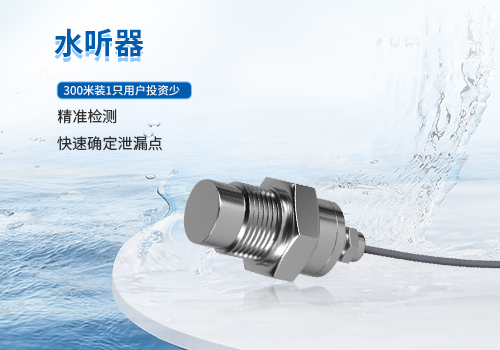
The dual hydrophone ranging method is an efficient and low-cost leak point localization technology, suitable for trenchless detection of small to medium-sized pipelines. By optimizing sound speed compensation, multi-hydrophone arrangement, and signal processing algorithms, localization accuracy and anti-interference capability can be further improved. In the future, combined with AI and IoT technologies, this method will advance toward intelligent and automated development.