
Practice of Dayu Ultrasonic Leak Detection Sensors in Leak Management of Complex Pipe Networks
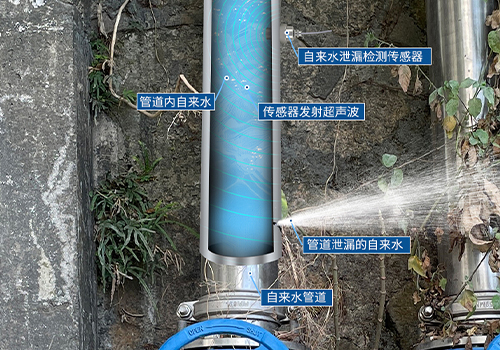
Ultrasonic acoustic leak detection: escaping water generates noise, and correlators analyze the noise to locate the leak point. When a leak occurs, the application of noise correlators is explained in detail through demodulated signal detection, solving the problem of traditional listening methods being inapplicable.
The principle part should include acoustic wave generation, sensor capture, and signal processing. Application scenarios may include underground pipelines, complex areas, and long-distance pipelines. Technical advantages include high precision, trenchless operation, and real-time monitoring. Case examples include the Qingpu competition and the Fuzhou contract water-saving project.
In summary, the answer structure should be:
1. Principle: acoustic wave generation, sensor capture, signal processing (correlation analysis)
2. Application scenarios: underground/complex areas, long-distance pipelines, real-time monitoring
3. Technical advantages: high precision, trenchless, real-time
4. Typical cases: Qingpu competition, Fuzhou project (if applicable)
5. Development trends: multi-modal fusion, intelligence, self-powering
Noise detection sensors in water pipeline leak detection are based on the principle of acoustic wave propagation, achieving precise location by capturing the characteristic acoustic signals generated by leak points. The following is a professional analysis from four dimensions: technical principle, application scenarios, typical cases, and development trends.
I. Technical Principle and Core Mechanism
Acoustic Wave Generation Mechanism
When a pipe leak occurs, water gushing from the crack creates high-frequency noise (2-20 kHz) due to friction with the pipe wall, while the sudden pressure drop triggers a water hammer effect, generating low-frequency vibration waves (0.1-1 kHz). These composite acoustic waves propagate through the pipe medium and surrounding soil, forming detectable acoustic signatures.
2. Sensor Working Principle
Passive detection: Uses high-sensitivity microphone arrays (such as noise correlators) to receive acoustic signals, with dual sensors synchronously collecting data and employing time-difference algorithms to calculate the leak location (formula: L=(v(t2-t1))/2, where v is the acoustic wave propagation speed in the pipe).
Active detection: Uses acoustic transmitters to inject specific frequency signals (e.g., 40 kHz) into the pipe, monitoring the attenuation characteristics of acoustic waves at the leak point, suitable for complex pipe network environments.
Signal Processing Technology
Wavelet transform and Fourier analysis are used for spectral decomposition, combined with digital correlation algorithms to eliminate environmental noise interference. For example, in the Shanghai Qingpu water supply case, noise reduction improved the signal-to-noise ratio to above 35 dB, achieving 0.1-meter-level location accuracy.
II. Typical Application Scenarios and Implementation Key Points
1. Underground Concealed Pipeline Detection
Applicable scenarios: Municipal pipe networks with burial depth >1.5 meters or complex overburden
Implementation process:
① Pressure zone location (areas with pressure drop >5%)
② Sensor grid deployment (spacing 50-100 meters)
③ Three-dimensional acoustic imaging (combined with ground-penetrating radar data)
2. Long-Distance Water Transmission Pipeline Monitoring
Typical architecture
graph LR
A[Pressure sensor] --> B[Noise sensor]
B --> C[Edge computing node]
C --> D[Cloud platform]
D --> E[AI leak prediction model]
Data processing cycle: from signal acquisition to leak warning <15 minutes, allowing leak rates to be reduced to below 5%.
III. Typical Case Analysis
Shanghai Qingpu Skills Competition Project
Adopted a combined solution of noise correlators and infrared thermography, detecting 6 effective leak points (out of 9 total) in a 2.3-km pipe network. The characteristic frequency of leak points was concentrated in the 8-12 kHz range, and the detection time per point was reduced from 45 minutes with traditional methods to 8 minutes.
Fuzhou Laocangshan Area Treatment
Deployed 200 noise sensor nodes combined with DMA zone metering, reducing annual water leakage from 280,000 tons to 96,000 tons, with a payback period of only 14 months (equipment cost approximately 3.8 million yuan per area).
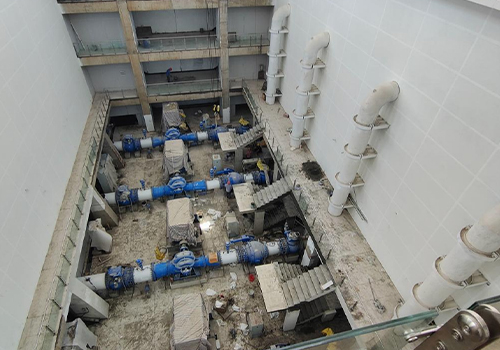
The following is an application of hydrophones installed on a valve factory's self-inspection pipeline, solving on-site point issues through guided installation.