
Doppler Flowmeter: A Reliable Assistant for Urban Drainage Monitoring! [Dayu Electronics]
Doppler flowmeters, with their unique working principle and adaptability, have become essential tools in urban drainage and channel monitoring. The following provides an in-depth analysis from three dimensions: technical principles, application advantages, and real-world scenario requirements:
1. Deep Dive into Technical Principles
1. Application of the Doppler Effect: By emitting high-frequency sound waves (1-5MHz) or electromagnetic waves into the water, which are reflected by suspended particles and bubbles, the flow velocity is calculated using the frequency shift (Δf) between the emitted and received frequencies: Δf = 2f?v·cosθ/C, where f? is the emitted frequency, v is the flow velocity, θ is the beam angle, and C is the speed of sound. Typical accuracy reaches ±1-3%.
2. 3D Flow Velocity Profile Reconstruction: Modern devices use multi-probe arrays (e.g., 3 beams arranged at 120° intervals) to vectorially synthesize the average cross-sectional flow velocity, eliminating turbulent flow interference. For example, the SonTek series from the USA can cover a wide range of 0.02-5m/s.
2. Core Application Advantages
1. Adaptability to Complex Media: It demonstrates strong tolerance to wastewater containing sediment (suspended solids concentration up to 50g/L) and oil, giving it an advantage over electromagnetic flowmeters (which require conductivity >5μS/cm). A case from Beijing Drainage Group shows a 98% online rate in combined sewer pipes with SS up to 2000mg/L.
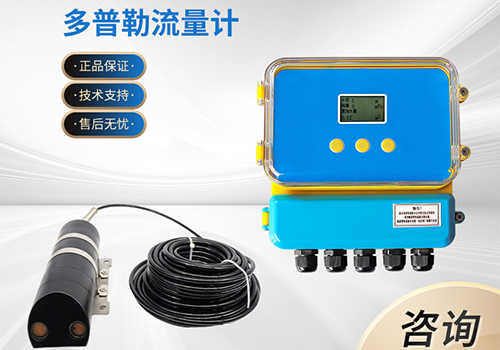
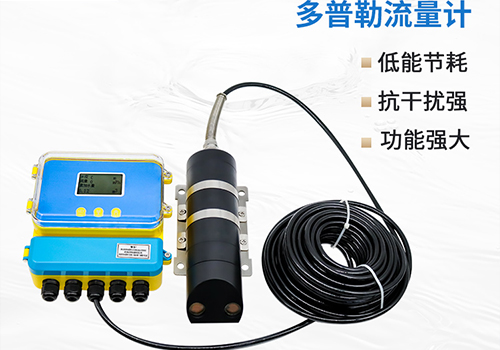
2. Partial Fill Measurement Capability: The sensor is installed inverted at the top of the pipe, using a pressure sensor to simultaneously acquire water level (accuracy ±2mm), and calculating flow based on cross-sectional geometry parameters. It can adapt to 10-100% fill conditions, solving the monitoring challenges of traditional instruments during low water levels in dry seasons.
3. Dynamic Response Characteristics: With a sampling frequency of 128Hz, it can capture second-level flow velocity fluctuations. In the Chengdu Smart Drainage project, it successfully alerted three times to abnormal piping surges before flooding (velocity dropped by 80% for 15 seconds), providing warnings 7 minutes earlier than traditional methods.
3. Key Points for Engineering Selection
1. Installation Optimization
? Straight Pipe Requirements: Upstream ≥10D, downstream ≥5D (D is pipe diameter), avoid disturbances from elbows and gate valves
? Sensor Immersion Depth: Minimum 30mm to prevent interference from foam layers on the water surface
? Typical Installation Angle: For a 15° beam angle, the tilt should be <5° to ensure effective acoustic beam coverage of the main flow area
2. Data Correction Strategies
? Temperature Compensation: Built-in PT1000 sensor automatically corrects the speed of sound (each 1°C change in water temperature causes a 0.2% error)
? Sediment Compensation: Dynamic correction of concentration effects through echo level; research by the China Institute of Water Resources and Hydropower Research shows it can reduce flow velocity errors by up to 65% at high turbidity (NTU>500)
3. System Integration Solutions
? Power Supply: Off-grid solar + supercapacitor system, supporting 72 hours of continuous operation in rainy weather
? Communication: NB-IoT + LoRa dual-mode transmission, with a measured 40% improvement in penetration in underground tunnels in a Beijing project
? Diagnostics: Self-calibration functions (e.g., RoweTech devices' ACT self-check protocol) automatically identify probe contamination, battery degradation, and other faults
4. Comparative Analysis
Compared with ultrasonic transit-time methods, the Doppler type improves accuracy by 2 times at low flow velocities below 0.3m/s; compared with mechanical instruments (e.g., propeller-type), the maintenance cycle extends from 3 months to 2 years. A river monitoring project in Shenzhen showed a 57% reduction in comprehensive operation and maintenance costs.
With the integration of edge computing technology, new devices (e.g., HACH Sigma950) have achieved local FFT spectrum analysis, enabling the modeling of cross-sectional flow fields within 30 seconds. In the future, combined with AI algorithms, it is expected to enable predictive analysis of pipe network siltation, further enhancing the intelligence level of urban drainage systems.