
Radar Level Meter Industrial Application: Measuring Liquid Level Height in Stirred Tanks [Dayu Electronics]
When measuring liquid level height or material level height in industrial tanks, it is necessary to consider whether the tank is open-top or closed. For closed tanks, in addition to temperature and pressure, the properties of the measuring medium must also be considered. For open tanks, only temperature and the measuring medium need to be considered. However, there is also a special case: when the liquid inside the tank requires stirring, there will be stirring blades present. In such working conditions, measuring the liquid level height can only be done using non-contact level meters. Common non-contact level meters include ultrasonic level meters and radar level meters. Next, let us look at a very special working condition:
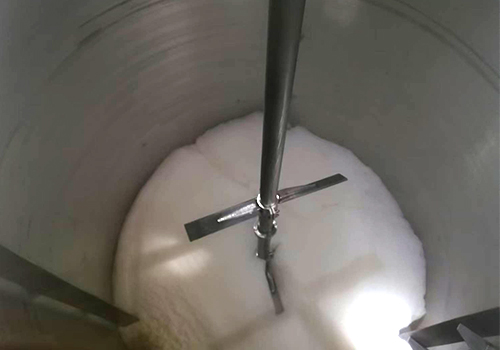
Stirred tank accompanied by a large amount of foam
As can be seen from the figure above, this stirred tank not only has stirring blades but also produces severe foam during production. The foam characteristics are: fine and dense, with a thickness of more than 20 cm. At this point, if an ultrasonic level meter is chosen, the fine and dense foam has very strong signal attenuation, and with a thickness of more than 20 cm, almost no ultrasonic signal can return. At this point, we try using an 80GHz FMCW radar level meter for measurement.
Product Features:
1. The 80G radar level meter offers measurement accuracy up to ±2mm, with a minimum blind zone of 0.1m.
2. A smaller antenna size meets the measurement requirements of more working conditions.
3. Multiple lens antennas provide a narrower emission angle, more concentrated energy, and stronger echo signals. Under the same working conditions, it offers higher reliability compared to other radar products.
4. It has stronger penetration and can operate normally even with adhesion and condensation.
5. A larger dynamic signal range provides more stable measurement for low dielectric constant media.
6. Multiple measurement modes are available, and in fast measurement mode, the radar response time is less than 1 second.
Based on the site conditions, we can only choose products with strong echo signals and more concentrated energy, as they have stronger penetration capability and can penetrate foam over 20 cm thick. The product also features a memory function that records measurement errors.
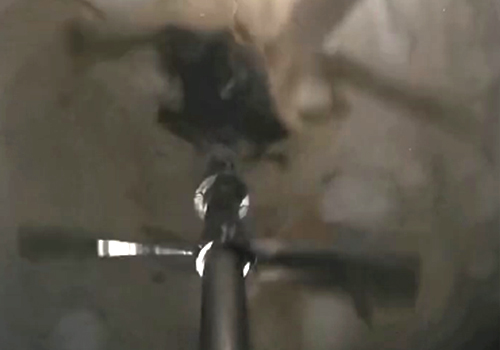
Internal condition of the tank during operation
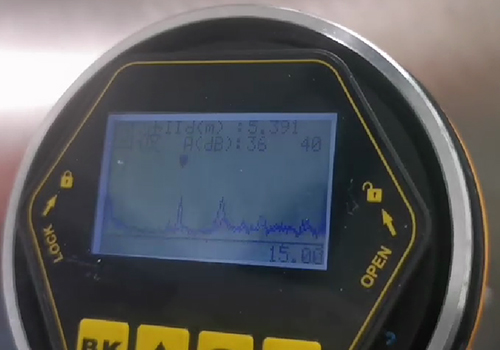
After installing the 80GHz radar level meter and commissioning the product settings to enhance the transmitted signal strength, the product features adaptive and self-memory functions. The figure above shows the echo signal strength of the radar level meter when the tank is working. We can clearly see the echo signal strength, and the liquid level measurement is stable.