
Aluminum Melt Leakage Sensor User Manual [Dayu Electronics]
I. Operating Environment
In aluminum plants, pouring molten aluminum into molds to produce aluminum rods, ingots, etc., involves certain hazards.
Mixing water with molten aluminum is a dangerous combination.
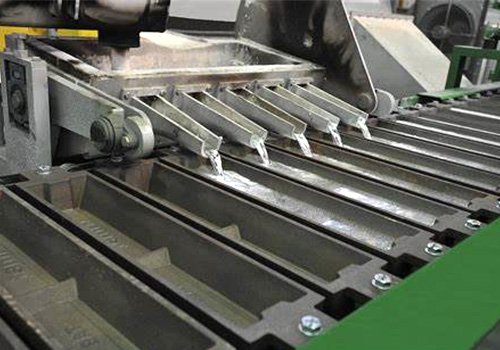
If a small amount of molten aluminum is slowly introduced into a pool of water, the heat from the aluminum is quickly absorbed by the water, and generally no danger occurs.
However, if a large quantity of high-temperature molten aluminum mixes with a small amount of water, the aluminum rapidly heats the water, leading to a "flash vaporization" event.
The melting point of aluminum is around 660°C; when it contacts water, it rapidly evaporates the water, and as the water instantly turns into steam, its volume expands by 1000 to 1700 times, a phenomenon known as "flash vaporization." Therefore, when adding metal to a smelting furnace, the metal must be kept dry and free from water.
This "flash vaporization" causes rapid volumetric expansion of water, ultimately resulting in an "explosion." The reaction between hot molten aluminum and water generates hydrogen gas, which intensifies the explosion. The blast can splatter molten metal over a wide area, causing personal injury or equipment damage.
If workers operate improperly, residual molten aluminum can leak into cooling water, instantly generating a massive steam shock wave, leading to a "flash vaporization" of the cooling water, which can also cause accidents.
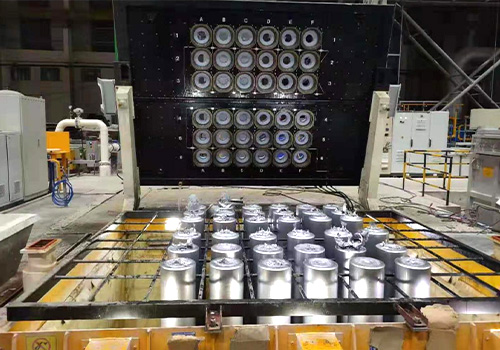
The reaction between high-temperature molten aluminum and water involves two processes: physical explosion and chemical explosion.
A physical explosion occurs when molten aluminum meets cold water. The temperature of the aluminum is far above the boiling point of water, causing the water to vaporize instantly in this superheated state, expanding by 1000 to 1700 times. The pressure wave generated by the steam is highly destructive, and the released shock wave can hurl molten aluminum over significant distances. This alone can have severe consequences.
A chemical explosion is due to the high reactivity of aluminum. Aluminum atoms react with water molecules to form aluminum oxide and hydrogen gas, releasing a large amount of heat. Once the oxygen from the water molecules is taken by the aluminum, the remaining hydrogen is highly flammable and explosive.
Particularly in confined spaces like casting pits, the pressure wave expansion can generate enough energy to potentially overturn the entire casting mold setup.
Over the past 30 years, some aluminum plants globally have records of such explosions.
II. Technical Specifications
l Measurement Range: 100 Hz to 10,000 Hz for aluminum melt leakage
l Measurement Sensitivity: Minimum -173 dB
l Supply Voltage: DC 6.0 to 9.0 V
l Withstand Voltage: Maximum ≤12.0 VDC
l Operating Current: ≤15 mA during continuous operation
l Power Source: Battery-powered only
l Cable Length: Standard 2 meters
l Withstand Pressure: Up to 100 meters of water head
l Withstand Temperature: -20°C to +150°C in water
l Grounding: Must be properly grounded; the shield wire should be connected to the ground wire (black).
l Storage Temperature: -40°C to +80°C
l Storage Pressure: Atmospheric pressure
l Storage Humidity: 0 to 95% RH, non-condensing
l Accessories: USB interface data acquisition card
III. Application Scope
l Aluminum melt leakage detection
l Steel melt leakage detection
l Leakage detection in hot-top aluminum billet continuous casting machines
IV. Wiring Instructions
l (Black) Ground
l (Red) DC power supply
l (Yellow) AC signal output
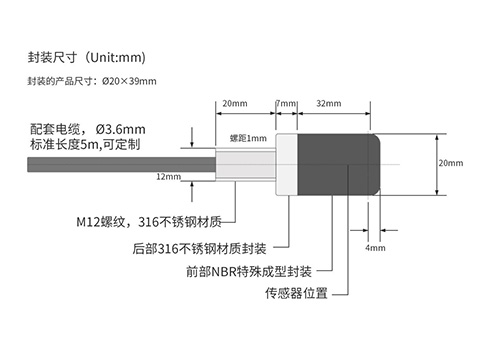
V. Structural Dimensions (Unit: mm)
VI. Installation Method
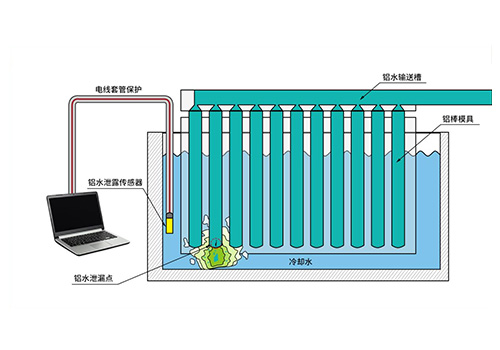
1. The aluminum melt leakage sensor should be installed in the water of the casting pit or cooling pool, generally at least 50 cm below the water surface, and should not contact the bottom of the casting pit or cooling pool.
2. The cable between the sensor and the computer must be routed through a protective conduit to prevent abrasion or damage on-site. If the sensor cable is worn, it can lead to erroneous received signals or even sensor damage.
3. The sensor installation position should not be subject to water flow impact that could cause collisions between the sensor and hard objects such as pool walls or molds.
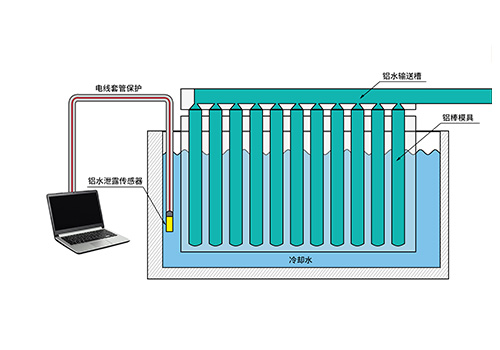
4. When the aluminum melt leakage sensor detects signals from aluminum melt leaking or falling into the water, it outputs the signal to the computer in real time.
VII. Precautions
1. The aluminum melt leakage sensor must not come into direct contact with molten aluminum, as the temperature of molten aluminum is around 660°C, while the sensor's maximum temperature tolerance is 150°C. Direct contact would melt and damage the sensor.
2. The sensor should be positioned away from water inlet points of the casting pit or cooling pool to prevent water flow from impacting the sensor and causing additional interference.
3. All power must be supplied by batteries only. If AC-to-DC power supplies are used, field validation has shown that both switching power supplies and bench linear power supplies introduce significant interference to the measurement signals.
4. The cable between the sensor and the computer must not be spliced; the required cable length should be confirmed at the time of ordering. Signals from aluminum melt leakage are weak, and any intermediate connections could easily be drowned out.
5. The aluminum melt leakage sensor picks up all signals generated by aluminum melt leakage, such as acoustic signals. During collection, it receives all surrounding sound and other signals and transmits them to the computer. Determining whether a sound is actually due to aluminum melt leakage requires analysis software on the computer.
6. Typically, an alarm light should be installed on-site, controlled by the computer analysis software, to trigger an alarm in the event of aluminum melt leakage.
VIII. Additional Questions
1. On-site measurement may require 24-hour continuous operation. If battery-powered, what battery capacity is needed for one year of use?
For 24-hour continuous operation and solely supplying the aluminum melt leakage sensor, calculated over 365 days per year, a 9V 150AH lithium battery would be required.
2. Is a lithium battery the only option for power supply?
Lithium, nickel-metal hydride (NiMH), and lead-acid batteries are all acceptable, provided the voltage is accurate and the battery produces no ripple or noise.
3. Can I use a high-quality switching power supply?
So far, the most expensive switching power supply used on-site (costing over 500 per unit) still exhibited electromagnetic interference. Therefore, please use pure battery power.
4. Why is a switching power supply not suitable?
The operating principle of the aluminum melt leakage sensor does not allow filtering in the circuit, because the aluminum-water reaction produces a signal across a very wide frequency range. Therefore, the sensor must capture all signals and transmit them to the computer for software analysis. Switching power supplies, and even bench linear supplies, produce varying levels of electromagnetic interference, the frequencies of which can drown out the aluminum melt leakage signals received from the water. Thus, battery power is required.
5. Is it necessary to use a protective conduit for the cable between the sensor and computer? It's inconvenient.
In past on-site applications, the sensor is placed in the casting pit or cooling pool, and the cable runs through the working area to the computer. Cable abrasion, corrosion, and damage are unavoidable, so a protective conduit is mandatory.
6. Since the sensor doesn't directly indicate whether a leak is present, why is computer software necessary?
The sensor's function is to receive all signals in the water, but its own processing capability is insufficient; the computer is needed for adequate analysis.
Additionally, detecting aluminum melt leakage requires collecting and comparing many signals over time, which exceeds the sensor's processing capacity.
7. What does the computer software handle?
It processes the collected signals, primarily acoustic and ultrasonic signals. It filters out ground vibrations, footsteps, on-site equipment vibrations, and other ambient noise through comparison, leaving only the acoustic signatures of aluminum melt leakage.
8. How difficult is it to develop the computer software?
It requires software engineers with expertise in audio signal processing, performing Fourier transforms and other analyses to identify aluminum melt leakage signals.
Assessing the difficulty is subjective.