
How to Resolve Mismatch Between Ultrasonic Level Meter Milliampere Value and PLC [Dayu Electronics]
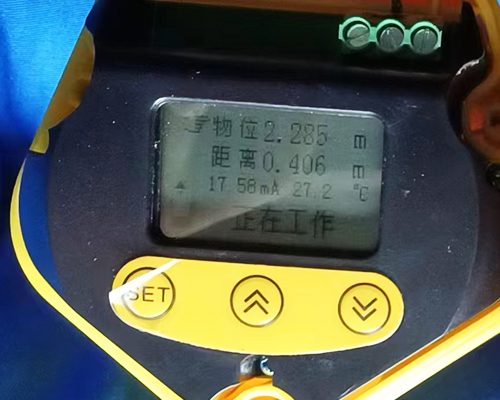
A customer in Shanxi discovered on site that the milliampere value of the integrated ultrasonic level meter did not match the PLC. They contacted Dayu's technical staff, and under their guidance, used a multimeter to test the milliampere output. A deviation was found, and after adjusting the 4mA and 20mA calibration values, the device worked properly.
Another customer in Zhejiang sent Dayu's after-sales team an ultrasonic level meter echo chart to check whether the readings were correct. From the echo chart, two peaks can be seen, meaning the ultrasonic waves reflected off two flat surfaces, indicating that the riverbed bottom was uneven. Looking at the two rows of numbers, the value 0.039 m in the lower right corner represents the liquid level reading, which is incorrect. This can only be resolved when there is actual water level present for proper display.
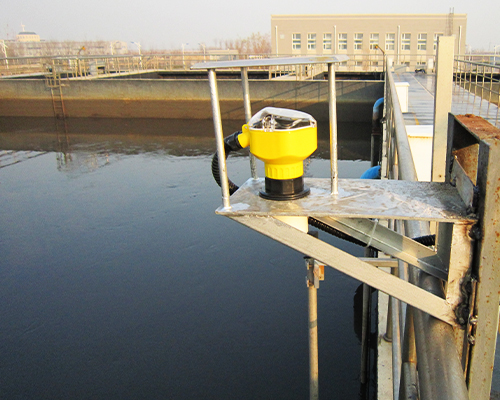
Speaking of echo charts, it is necessary to explain the working principle of the ultrasonic level meter. The ultrasonic level meter works by having the ultrasonic transducer (probe) emit high-frequency pulse sound waves that hit the surface of the measured material, are reflected back, and the returning echoes are received by the transducer and converted into electrical signals. Therefore, the measured surface must be flat; if the surface is uneven, signal interference can occur, resulting in inaccurate measurement data.
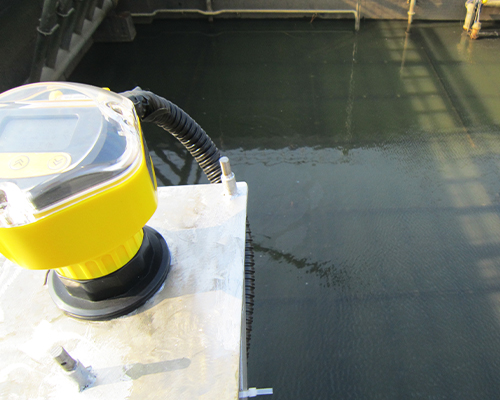
Because the ultrasonic level meter uses non-contact measurement, the measured medium is almost unrestricted, and in recent years it has been widely used for measuring the height of various liquids and solid materials.