
M80 Underwater Obstacle Avoidance Sensor Measurement Principle and Technical Implementation [Dayu Electronics]
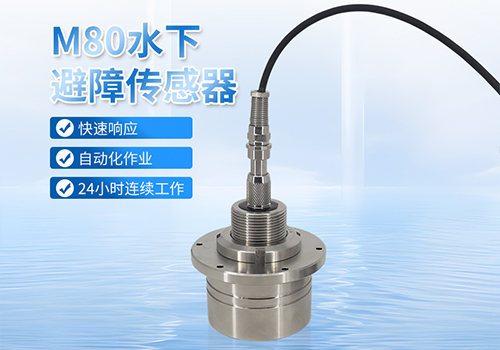
M80 Underwater Obstacle Avoidance Sensor is based on the high-frequency ultrasonic ranging principle, achieving underwater environment perception by actively emitting sound waves and receiving reflected signals. Its core measurement process can be divided into three stages: sound wave emission, signal reception, and data processing, combined with high-precision algorithms and industrial-grade hardware design to ensure reliable ranging in complex water environments.
1. Sound Wave Emission and Reception Mechanism
The sensor uses a piezoelectric ceramic transducer to emit narrow-pulse ultrasonic waves at frequencies of 300kHz-1MHz. This frequency band balances propagation attenuation in water and resolution requirements: the low frequency band (300kHz) is suitable for long-distance detection, while the high frequency band (1MHz) enhances near-field resolution. The emitted sound wave spreads at an 8.5° cone angle, forming a directional detection beam in water, effectively reducing multipath interference. The reception module uses a synchronous trigger mechanism to start the high-sensitivity receiving circuit immediately after sound wave emission, capturing the echo signals reflected from targets.
2. Time-of-Flight Ranging Principle
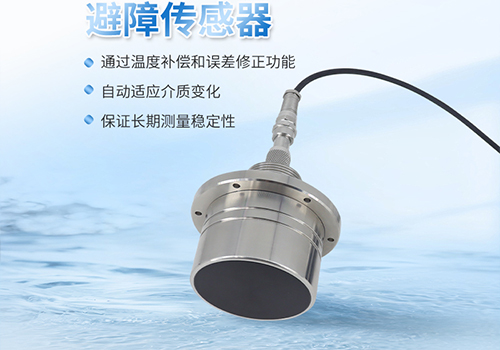
The system uses the Time-of-Flight (TOF) algorithm to calculate distance: a high-precision timing chip measures the time difference (Δt) from sound wave emission to reception, combined with the sound velocity parameter (1500 m/s in fresh water at normal temperature) to calculate target distance (D=C×Δt/2). To eliminate temperature effects, the sensor is equipped with a PT1000 temperature sensor that corrects the sound velocity parameter in real time (sound velocity temperature coefficient: 2.4 m/s/°C). At a water temperature of 20°C, the system achieves ranging accuracy of ±0.5%, and the blind zone distance is controlled within 2 meters.
3. Multi-Mode Data Processing
The sensor supports the RS485/Modbus-RTU protocol and can output 5-10 sets of measurement data per second. A dynamic threshold adjustment algorithm automatically filters out interference signals such as water surface fluctuations and suspended particles. In water bodies with a flow velocity of 2 m/s, the system uses a Kalman filter algorithm to smooth continuous measurement values, ensuring data stability in dynamic environments. For moving target detection, the sensor can be configured with a predictive tracking mode, using historical trajectory analysis to improve target capture probability.
4. Industrial-Grade Environmental Adaptability
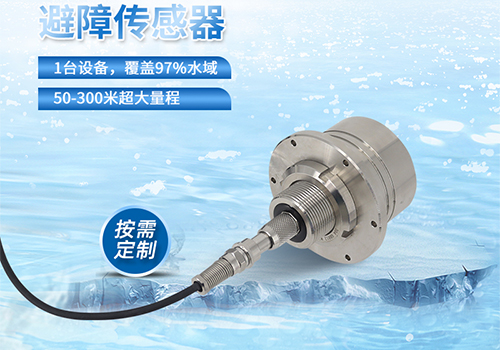
With IP68 protection rating and PVDF plastic shell design, the sensor can operate stably in water temperatures from -20°C to 60°C and at depths of up to 100 meters. The low-power circuit design (current <60mA at 24V supply) supports long-term underwater deployment. In practical applications, this sensor has been successfully used in scenarios such as underwater robot obstacle avoidance and pipeline inspection, achieving centimeter-level positioning accuracy at a water depth of 30 meters, verifying its technical reliability.