
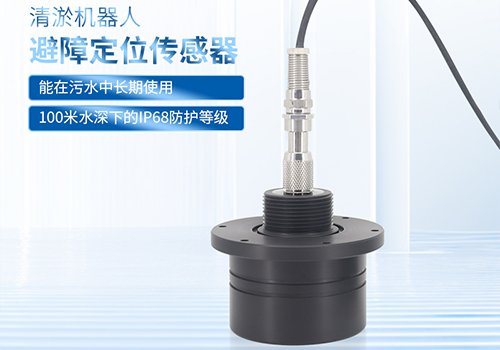
Dayu M80 Ultrasonic Sensor: The "Underwater Eye" of Dredging Robots
In enclosed, turbid working environments such as sewage pipes, sedimentation tanks, and septic tanks, dredging robots face severe challenges including extremely low visibility and diverse obstacle shapes (e.g., pipe wall protrusions, hardened sediment blocks, unexpected debris). Accurate obstacle avoidance becomes a core requirement for operational efficiency and equipment safety. Ultrasonic sensors, with their unique advantages, have become an indispensable "perceptual organ" for such robots.
1. Working Principle: Acoustic Ranging, Penetrating Turbidity
Ultrasonic sensors act like the robot's "ears" and "sonar." They emit high-frequency ultrasonic pulses through piezoelectric ceramic elements, which propagate through water or air and reflect off obstacles. The sensor receives the echo and precisely calculates the time difference between transmission and reception (time-of-flight method). Combined with the known propagation speed of sound in the medium (approximately 1500 m/s in water), the exact distance between the robot body and obstacles can be calculated in real time. This detection method, based on physical acoustics, is completely unaffected by water turbidity, dim lighting, or dark underwater conditions—a key advantage that optical cameras or LiDAR cannot easily achieve.
2. Dredging Obstacle Avoidance Applications: Real-Time Protection, Flexible Response
On dredging robots, ultrasonic sensors are often arranged at multiple angles on the front, sides, and even the bottom, forming a 360° or key-sector detection network:
1. Forward Warning: Continuously detects the distance to obstacles directly ahead during movement. When the detected distance falls below a preset safety threshold (e.g., 30 cm), the control system immediately issues a deceleration or stop command to avoid direct collision.
2. Side Collision Prevention: When operating in narrow pipes or near tank sidewalls, side sensors monitor the distance between the robot and the pipe/wall in real time. If the distance becomes too close, the system automatically adjusts the direction or posture to ensure the robot stays in the safe central area of the channel, preventing scraping or jamming.
3. Bottom Anti-Grounding/Anti-Boulder: Bottom sensors monitor the distance to sludge at the tank bottom or hidden large rocks, preventing the robot from sinking too deep into sludge or being damaged by boulders from underneath.
3. Core Advantages: Reliable Choice in Muddy Environments
1. Unaffected by Turbidity: Sound waves penetrate turbid water and sludge with strong performance and stable reliability, making it the ideal choice for underwater and harsh-visibility environments.
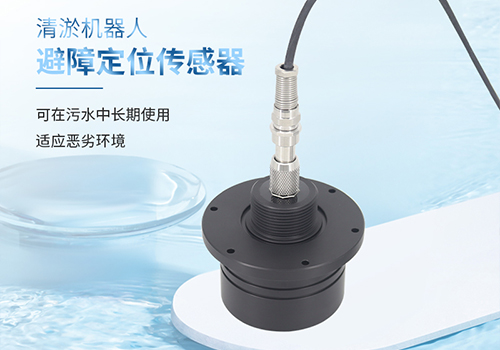
2. Waterproof and Durable: The sensor body typically has IP67/IP68 waterproof and dustproof ratings, capable of withstanding underwater pressure and sludge corrosion.
3. Fast Real-Time Response: Short detection cycles (millisecond level) provide near-real-time distance information, meeting the high-speed response requirements for robot obstacle avoidance.
4. High Cost-Effectiveness: Compared to complex LiDAR or underwater imaging sonar, ultrasonic sensors are low-cost, easy to maintain and replace, and suitable for large-scale deployment.
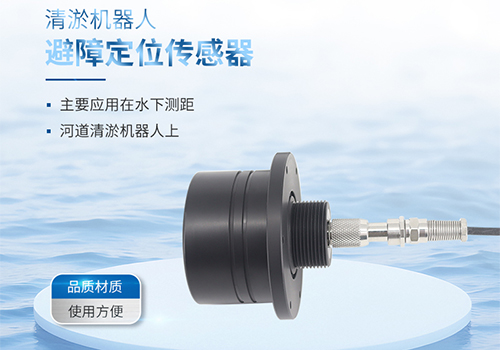
A municipal sewage pipe dredging robot was equipped with six Dayu Electronics M80 ultrasonic sensors (2 front, 2 side, 2 bottom). During a task to clear a severely clogged pipe, the robot used its front sensors to detect a severe pipe wall deformation caused by root intrusion 0.5 meters ahead in the turbid muddy water. The control system immediately initiated emergency braking and adjusted the travel angle, successfully avoiding the obstacle and preventing costly damage to the robotic arm or body, ensuring the smooth completion of the dredging task.
Ultrasonic sensors, with their "environmental adaptability, reliability, and economy," provide dredging robots with the key ability to "see clearly" and "avoid obstacles" in visual blind spots. They act as the robot's "eyes" and "guardians" in dark, turbid water, serving as an indispensable technological foundation for efficient, automated, and unmanned dredging operations. With the development of sensor fusion technology, the combination of ultrasonic sensors with inertial navigation (IMU) and short-range LiDAR will further optimize perception accuracy and obstacle avoidance intelligence in complex sludge environments, driving the dredging industry toward safer and smarter development.
If you have similar scenarios and need ultrasonic ranging and obstacle avoidance sensors, please feel free to contact: Chen Gong from Fuzhou Dayu, who will provide 1-on-1 recommendations for suitable sensors.