Dayu Electronics M33 Underwater Obstacle Avoidance Sensor for Underwater Ranging and Liquid Level Monitoring
In the fields of underwater distance measurement and liquid level monitoring, engineers often face this dilemma:
Want to measure the remaining fuel in a tank, but there are several millimeters of steel plate in the way — ordinary ultrasonic sensors simply give up;
Want to measure the oil-water interface — traditional float balls easily get stuck, and optical probes are afraid of oil contamination;
Want to install on moving vehicles or ships — wide voltage, vibration resistance, and IP68 waterproofing are all indispensable...
These scenarios may seem simple, but they actually impose stringent demands on the sensor's penetration capability, accuracy, stability, and environmental adaptability. There are not many options when it comes to finding a device that simultaneously delivers high precision, high protection, and flexible installation.
Is there a device that can combine high precision, high protection, and flexible installation, while easily handling the above problems?
Dayu Electronics M33 underwater obstacle avoidance sensor happens to address all of the above challenges one by one.
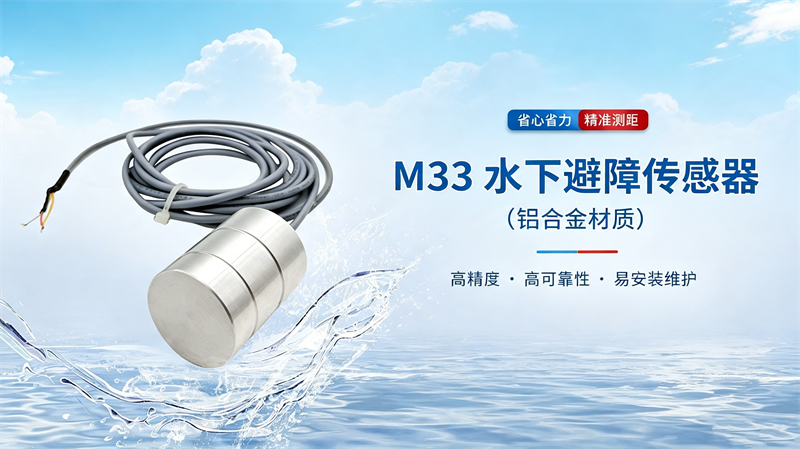
I. An "Underwater Eye" Born for Complex Working Conditions
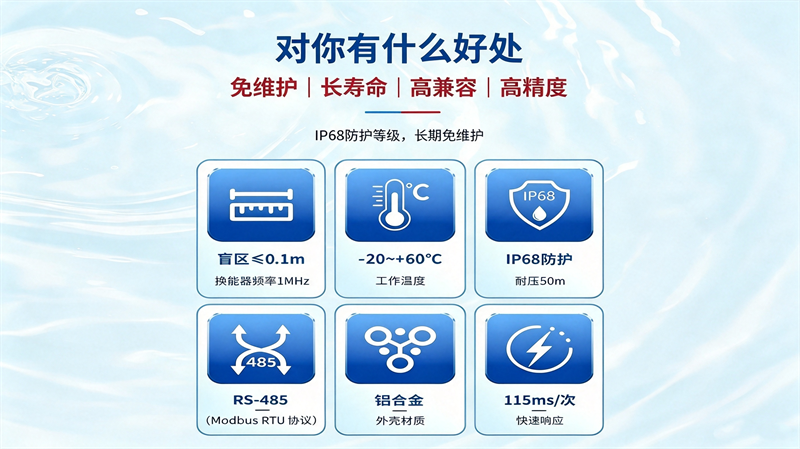
The Dayu Electronics M33 underwater obstacle avoidance sensor is not an ordinary level gauge in the traditional sense, but a series of ultrasonic sensors specifically designed for underwater distance measurement, obstacle avoidance, and liquid level monitoring. Featuring an aluminum alloy housing and IP68 fully waterproof design, it can withstand up to 50 meters of water pressure, with an operating temperature range of -20°C to +60°C. Whether in freezing outdoor environments or high-temperature engine rooms, it delivers stable and accurate data output.
The core difference lies in frequency — two models, each with its own strengths:
1MHz version: Strong penetration, specifically designed for "through-wall measurement"
1MHz mode: Strong penetration — can measure through steel plates. Direct measurement range in clean water is ≤6000mm; even through a 3mm steel plate, a range of ≤2000mm is guaranteed, making it suitable for external mounting on closed containers.
2MHz version: High precision, specifically designed for "close-range precision measurement"
2MHz mode: Higher precision — the blind zone for direct measurement in clean water is only ≤50mm, with a range of ≤3000mm, making it suitable for immersion-type precision measurement. Even through a 3mm steel plate, the range can still reach ≤1000mm.
Common features of both:
IP68 fully waterproof + pressure resistance up to 50 meters of water — from outdoor rainstorms to long-term underwater submersion, normal operation without water ingress
No mechanical moving parts — no trouble of float balls getting stuck, no anxiety of optical lenses being obscured by oil contamination
Power supply range DC 10.8~26.0V with reverse polarity protection — can be directly connected to cigarette lighter sockets, batteries, or industrial power supplies
Install it, power it on, and leave the rest to it — 24-hour uninterrupted monitoring, stable output for underwater depth measurement, distance measurement, and obstacle avoidance.
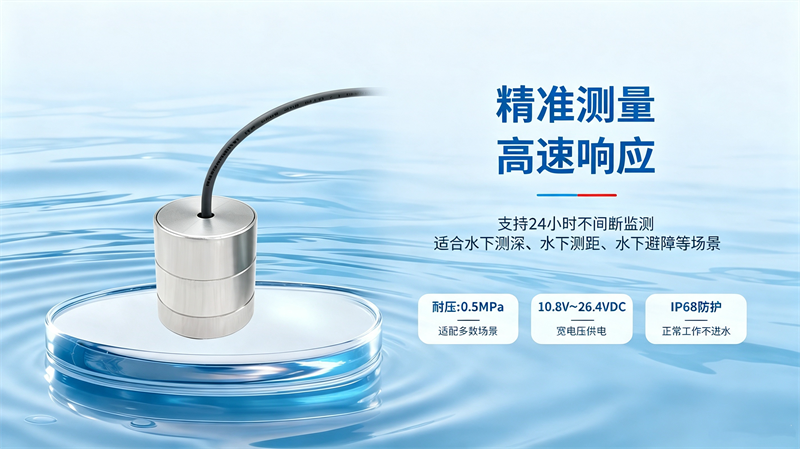
II. Three Major Advantages, Specifically Targeting Various "Hard-to-Measure" Conditions
1. High Precision + High Repeatability, Rock-Solid Data Stability
Measurement accuracy in clean water at room temperature: ±0.5%~1.0%;
Repeatability accuracy: ±0.5%, combined with automatic temperature compensation, maintaining stable output across different water temperatures, delivering true and reliable data.
2. IP68 Fully Waterproof + 50-Meter Pressure Resistance, Rugged Protection
Aluminum alloy housing with fully sealed structure. Whether it's a sprinkler truck operating in heavy rain, long-term submersion in outdoor rivers, or high-humidity environments in underground wells — normal operation without water ingress.
No mechanical moving parts — install it, power it on, and leave the rest to it.
3. Wide Voltage + Ultra-Low Power Consumption
Power supply range DC 11.0~26.0V with reverse polarity protection,
Regular batteries or AC-to-DC switching power supplies can both provide direct power.
Clear requirements for power quality: no electromagnetic interference, ripple <1.0%, voltage drop <2.5V.
No-load current ≤15mA, rated operating current ≤100mA;
Start-up delay <5.0s;
Even when powered by batteries (e.g., in remote field monitoring stations), it can operate stably for extended periods with extremely low power consumption.
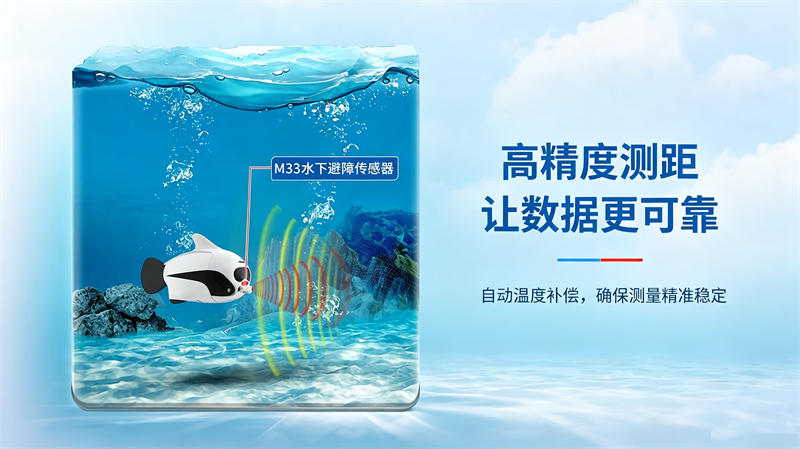
III. Core Parameters at a Glance
Parameter | Specification | On-Site Significance |
Measurement Range (clean water,20℃~30℃) | 1MHzDirect: ≤6000mm / Through 3mm3mmsteel plate: ≤2000mm 2MHzDirect: ≤3000mm / Through 3mm3mmsteel plate: ≤1000mm | Direct measurement for large containers, through-wall measurement for closed tanks — one device handles it all
|
Blind Zone | 1MHzDirect ≤100mm / Through plate ≤200mm 2MHzDirect ≤50mm / Through plate ≤100mm | Valid data can be obtained even in small spaces and at close range, without wasting installation positions
|
Measurement Accuracy | ±0.5%~1.0%(clean water at room temperature) | High reliability of critical process parameters, avoiding misjudgment or waste caused by errors |
Supply Voltage | DC 11.0~26.0V, with reverse polarity protection | Direct connection to vehicle batteries or on-site power supplies — no fear of reverse polarity burning out the device, saving the cost of a voltage regulator module |
Power Consumption | No-load ≤15mA, rated operation ≤100mA | Battery-powered operation is sustainable, suitable for remote monitoring stations without mains power |
Output Interface | StandardRS485(Modbus-RTU), optional4~20mA | Digital signals directly connect toPLCor cloud platforms; analog signals are compatible with legacy systems — whichever way you connect, it's convenient |
Protection Rating/ Pressure resistance | IP68, up to50meters of water pressure | No fear of outdoor water immersion or deep-water installation, reducing fault repairs caused by water ingress |
Operating Temperature | -20℃~+60℃ | Normal operation in northern winters and southern engine-room high temperatures alike — no seasonal shutdown required |
Housing Material | Aluminum orPPSUoptional | Aluminum is lightweight and durable for normal conditions; choosePPSUfor corrosion resistance in chemical applications — match as needed |
IV. Scenario Analysis: Selecting the Right Model Solves Half the Problem
Your Working Condition | Where the Trouble Lies | How M33 Solves It | Which Model to Choose |
RV fuel tank, closed reaction vessel | Metal tank cannot be drilled | Mount on the outer wall, penetrate3mmsteel plate to measure liquid level | 1MHz |
Underwater robot, narrow pipeline | Blind zone too large — by the time it detects, collision has already happened | Blind zone only20~30mm, can still report distance at close approach | 2MHz |
Oil-water interface, bottom water in crude oil tanks | Float balls get stuck, optical lenses get obscured by oil film | Ultrasonic does not discriminate by medium and is not afraid of oil contamination | Either model works |
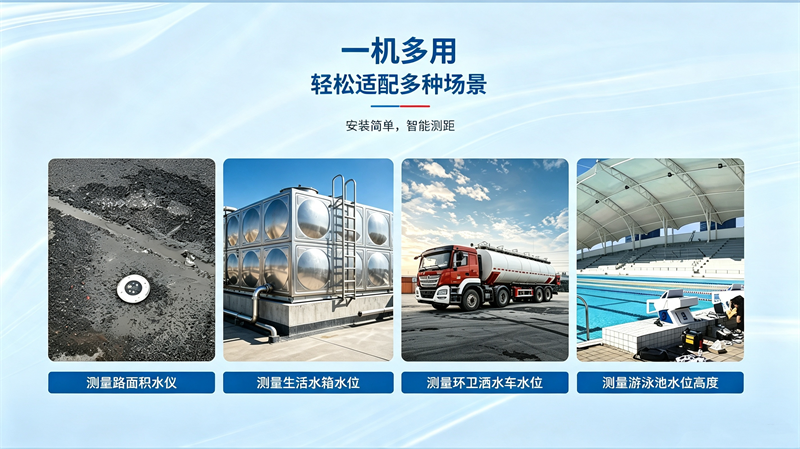
Sprinkler truck, tanker truck | Noisy power supply, high vibration, frequent washing | Wide voltage direct connection to vehicle power,IP68not afraid of washing or vibration | Either model works |
Chemical tank, corrosive medium | Standard housing gets corroded | Choose PPSU material for corrosion resistance with ultrasonic penetration | Either model works |
Whether a device performs well depends first on selecting the right model. The 1MHz handles penetration, the 2MHz handles precision — between the two M33 models, one will surely match your working conditions.
V. About Dayu Electronics
Since its founding in 2008, the company has been consistently focused on the R&D and industrialization of ultrasonic technology. From transducers to software and hardware, everything is independently developed, and products have been widely applied in meteorological monitoring, marine environments, industrial measurement and control, and other fields.
If you are grappling with a "hard-to-measure" liquid level condition, feel free to throw the challenge to Dayu — let's work together to see if this dual-frequency sensor can help you get it done.