
Dayu Electronics M18 Ultrasonic: One Sensor Solves Four Industrial Production Line Detection Challenges
In industrial automated production lines, sensors are the most basic yet often overlooked component. When companies analyze efficiency bottlenecks or reasons for line stoppages, sensors are often the “invisible culprit.”
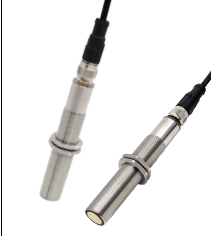
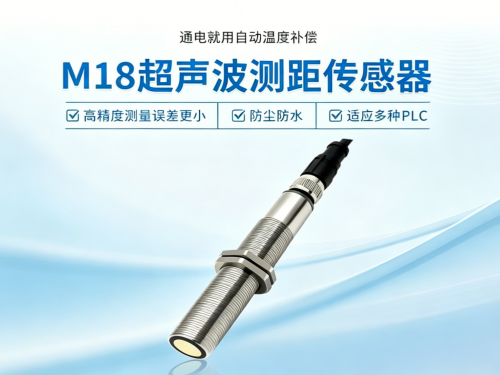
This article uses the Dayu Electronics M18 ultrasonic distance sensor as an example to analyze how technology selection directly impacts production line management efficiency, response speed, and detection reliability.
01
Common Problems: Four Unattributed Sensor Issues
Complex Selection:
Switching outputs, analog outputs, and RS485 stations require different models, with warehouses often stocking 4-5 variants, leading to high management costs and easy errors.
Inefficient Commissioning:
Modifying range or thresholds requires engineers to go on-site to disconnect and adjust, taking 20-30 minutes per session and affecting production line flexibility.
Poor Environmental Adaptability:
In oily, dusty, or humid environments, ordinary sensors frequently misread or fail, making line stoppage risks uncontrollable.
Detection Blind Spots:
Transparent workpieces (such as glass and film), black rubber parts, and highly reflective metals under strong light—photoelectric or laser sensors are unstable in these detections.
02
Actual Demands of Production Lines for Sensors
Companies generally expect sensors to have the following capabilities:
? A single model compatible with multiple output types, simplifying selection and inventory
? Support for remote parameter modification without on-site work
? High protection rating with a metal housing to withstand harsh conditions
? Detection unaffected by workpiece color, material, or ambient light
03
M18 Ultrasonic Sensor Solution
1. Multiple Output Compatibility
Supports NPN/PNP switching outputs, 4-20mA/0-10V analog outputs, RS485 Modbus RTU. One model covers the entire production line.
2. Remote Parameter Adjustment
Through the Modbus RTU protocol, the host computer can remotely modify range and switching thresholds without requiring personnel on-site.
3. High Reliability
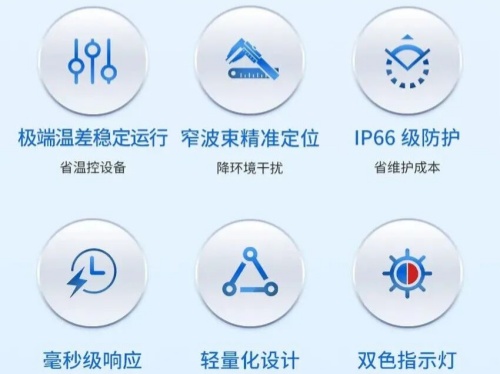
IP66 protection rating allows direct water washing; stainless steel housing resists corrosion and magnetic field interference. Suitable for oily, dusty, and humid environments.
4. Advantages of Acoustic Wave Technology
Based on sound wave reflection, it is unaffected by workpiece color, material, transparency, or ambient light, enabling stable detection of transparent glass, black rubber, reflective metals, etc.
04
Technical Comparison: Ultrasonic vs. Photoelectric vs. Laser
Scenario Ult rasonic Photoelectric Laser
Transparent/Black Workpieces Stable Prone to missed or false detections Usable but expensive
Oily/Dusty Environments Unaffected Requires cleaning Lens sensitive
Strong Light Interference Unaffected Easily saturated Needs filter
Unit Cost Hundreds of RMB Hundreds of RMB Thousands of RMB
Conclusion:
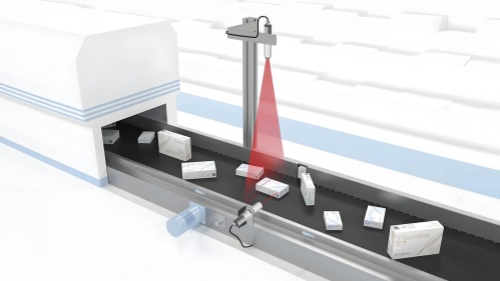
In common industrial production line scenarios such as material presence detection, level detection, obstacle avoidance, and packaging positioning, ultrasonic technology has better environmental adaptability than photoelectric and lower cost than laser. The M18 further optimizes beam angle, blind zone (60mm), and range (60~1000mm).
(Application case diagram of the M18 ultrasonic distance sensor in automated field)
05
Company Guarantees
Certifications: Complies with GB/T 14048.10-2016 and GB/T 14048.19-2013
Service: 12-month warranty, 48-hour technical response
Typical Customers: NARI, ABB, Gezhouba Group, Institute of Acoustics of the Chinese Academy of Sciences
Sample Testing: Free sample application available, actual testing for 7 days
If you are troubled by detection reliability or complex selection issues, you may apply for free sample testing.
06
About Dayu Electronics
Fuzhou Dayu Electronic Technology Co., Ltd. focuses on the R&D and manufacturing of ultrasonic technology.
Product range covers level meters, flow meters, level difference meters, open channel flow meters, transducers, industrial sensors, marine equipment, etc., widely applied in water conservancy, municipal, environmental protection, industrial, aquaculture, and other fields.