
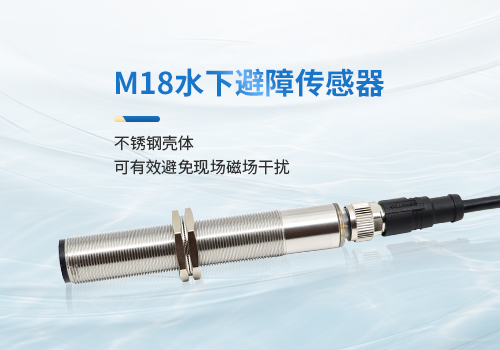
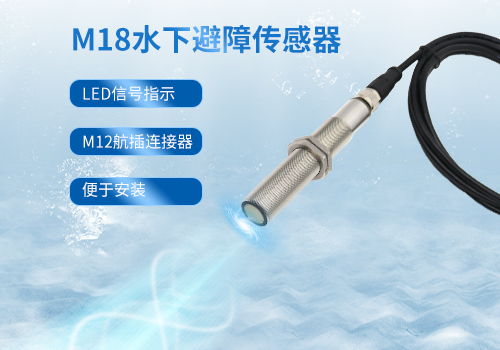
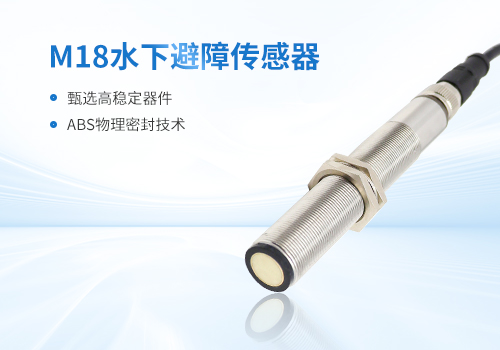
M18 Ultrasonic Distance Sensor for Displacement Applications [Dayu Electronics]
I. Measurement Principle:
During distance measurement, an ultrasonic signal is emitted by the ultrasonic probe, reflected by a liquid or other solid medium, and received by the same probe. The time difference between transmission and reception is measured to determine the level. The relationship between the sound wave transmission distance L, the sound velocity v, and the transmission time t can be expressed by the formula:
Ultrasonic distance measurement formula: L=1/2 vt
L: distance from the ultrasonic probe to the measured surface. Unit: m;
v: sound velocity after temperature compensation. Unit: m/s;
t: sound wave travel time within the measurement range. Unit: s
II. Main Technical Parameters:
Measurement range: 50mm~1000mm (blind zone: 50mm)
Resolution: 1mm
Measurement accuracy: ±0.5%
Repeatability accuracy: ±0.25%
Operating voltage: 10V~30V DC
Startup delay: <300ms
Operating temperature: -20~60℃
The product offers multiple output types:
1. 4~20mA analog output
2. 0~10V analog output (load ≥1k)
3. NPN switching output
4. Normally open PNP switching output
5. Standard RS485 output (Modbus-RTU protocol)
III. The distance sensor can be used for various measurements in product applications.
1. It can measure the liquid level in small containers of various volumes (temperature not exceeding 60℃, no evaporating medium);
2. Measure the distance from the sensor to a certain device (avoid the sensor's blind zone);
3. Measure the degree of displacement of an object and provide signals to control equipment;
4. Detect the presence or absence of an object on a specific device;
IV. Case Study:
Customer requirement: Install the ultrasonic distance sensor on a bracket at a preset installation position, and mount a reflector plate above the upper limit plate. The ultrasonic sensor measures the distance from the installation position to the reflector plate to determine the degree of displacement of the object.
Advantages of choosing this ultrasonic distance sensor:
1. High measurement accuracy: within ±0.5% of the measured value, and after linear compensation, almost zero-error measurement can be achieved;
2. Ultrasonic distance sensor has a long service life and can perform long-term measurements;
3. Multiple outputs are available: analog, switching, and digital;
4. Low maintenance cost: the sensor and cable use aviation connectors for quick replacement;
5. The product uses an M18*1 stainless steel threaded connection for easy and fast installation.