
Dayu Electronics: Which Water Level Meter to Choose for a 90 cm Diameter, 13 m Deep Well
Recently, a customer encountered a special working condition: the installation opening is only 90 cm in diameter, the vertical height is 13 m, but the normal water level is only 1–2 m deep. In this "deep well, shallow water" scenario, conventional water level meters are prone to pitfalls—either the beam doesn't reach the water surface, or well wall interference causes measurement jumps. For this site, we provide two feasible solutions for your reference.
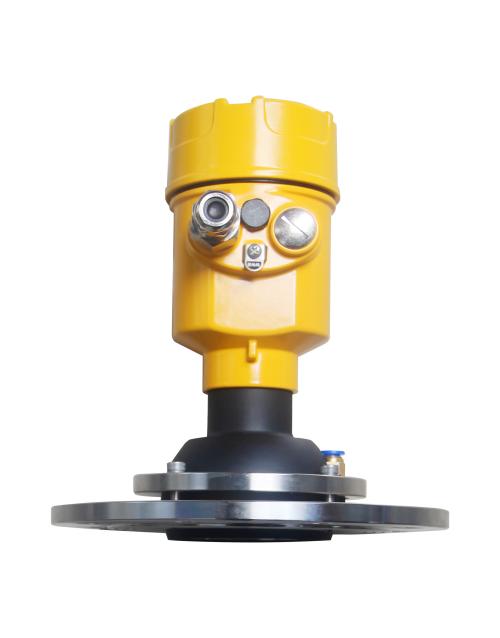
Preferred solution: 120G radar water level meter (non-contact)
The core consideration is the transmission angle. When the installation height is 13 m and the target water level is only 1–2 m, the coverage diameter of the radar beam at the water surface must be small enough to effectively avoid well wall reflections. Calculations show that the transmission angle of the water level meter must not exceed 4°; otherwise, the beam edge will sweep the well wall. If the well wall has grooves, protrusions, ladders, or flange connections, these protrusions will generate strong false echoes, directly causing measurement errors. Therefore, we recommend using a 120G high-frequency radar water level meter, whose beam angle can be controlled to about 3°–4°. At a height of 13 m, the beam coverage diameter is approximately 0.7–0.9 m, which fits perfectly with the 90 cm well opening inner diameter, and can accurately lock onto the water surface echo.
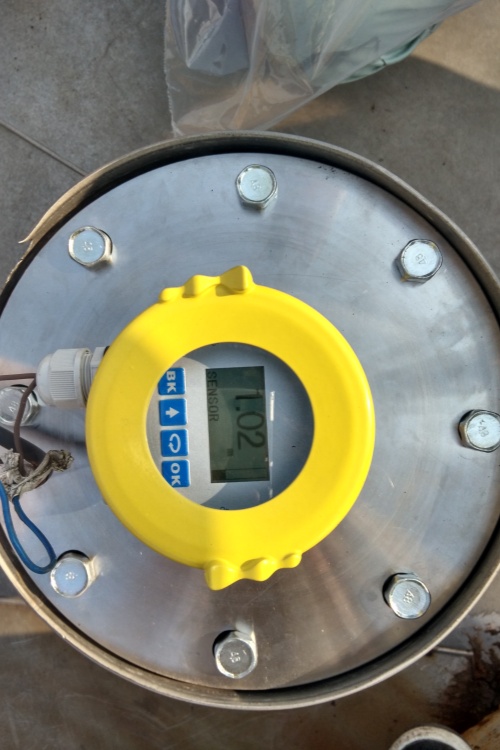
However, a reminder: this solution presupposes that the well wall is as smooth as possible from the water inlet to the water surface. If there are obvious obstacles or structural discontinuities on the well wall, the radar echo may still be interfered with. In that case, software filtering or manual setting of the echo threshold will be required to eliminate false signals.
Alternative solution: submersible level transmitter (contact type)
If the well wall conditions are not ideal, or the site requires extremely high stability, you can directly switch to a different measurement approach—a submersible level transmitter. The pressure sensor is directly submerged to the bottom of the well, and the water level height is converted from the hydrostatic pressure of the water column. This method does not rely on ultrasonic or radar waves at all. Whether the well wall is smooth or not, or whether there are obstacles, is irrelevant. The measurement result depends only on the water depth, offering very high reliability. During installation, simply lower the sensor cable from the well opening to the bottom and secure it. The 90 cm opening is more than sufficient for the operation.
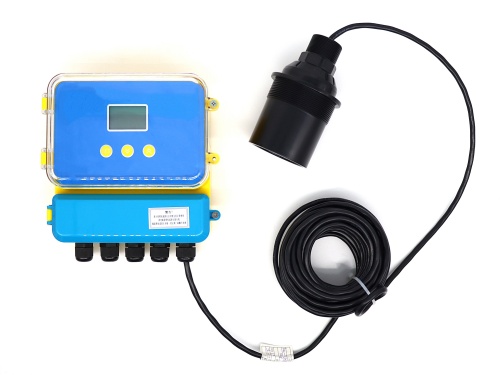
Selection recommendations
Each of the two solutions has its own strengths: if the well wall is relatively smooth and you prefer non-contact maintenance, the 120G radar water level meter is the priority; if the well wall is uneven or has many attachments, the submersible level transmitter is the more hassle-free choice. The specific choice depends on the actual condition of the well wall and the long-term stability requirements. If you have site photos or well wall structural diagrams, please send them to the Dayu Electronics technical team, and we can help you further confirm the solution details.