
Secrets to Pairing with Parshall Flume No. 9! Industrial Wastewater Monitoring Made Easy [Dayu Electronics]
Industrial wastewater discharge is mostly intermittent, with factories starting discharge only when storage reaches the capacity of a holding tank. Discharge volumes are regulated by the local industrial park management committee and the environmental protection bureau. Therefore, high-precision, high-stability flow meters are required for monitoring total wastewater discharge.
Most discharge uses pipe or channel intermittent flow; electromagnetic or ultrasonic flow meters are used for pipes, while Doppler or ultrasonic open-channel flow meters are used for channels. However, during flow monitoring, data stability can degrade if the on-site installation conditions do not meet measurement requirements. Let's look at a wastewater discharge case—using an ultrasonic open-channel flow meter paired with a Parshall flume No. 9 for wastewater flow monitoring.
The customer provided drawings of the Parshall flume No. 9:
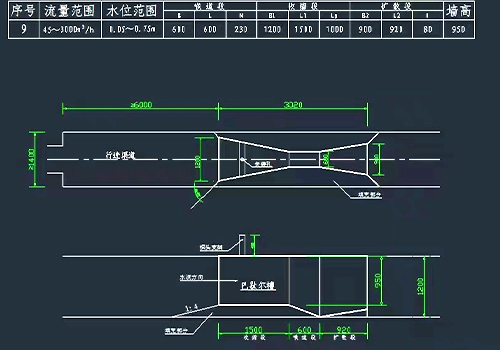
We selected a compatible ultrasonic open-channel flow meter for the customer, configured at the factory for the Parshall flume No. 9, with the reference zero point set to 1.25 meters per the customer's requirement. After on-site installation and setup, the data displayed as follows:
The customer reported significant fluctuations in the water level readings from the open-channel flow meter, so we asked them to send photos of the ultrasonic transducer installation:
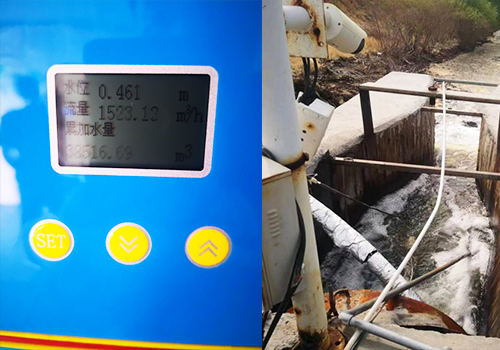
Based on the on-site installation, the customer provided a video of the discharge, where we could clearly see significant water level fluctuation and large splashes directly below the ultrasonic transducer (commonly known as the ultrasonic probe). Our preliminary assessment is that the straight channel in front of the Parshall flume inlet does not meet the basic installation requirement of a 10D upstream and 5D downstream straight run for the flow meter.
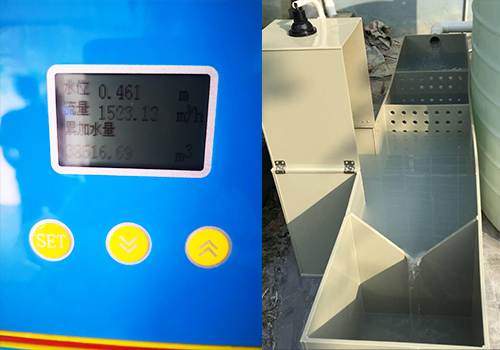
From the video, we observed that the discharge outlet is very close to the Parshall flume—only about 1 meter away—and the water surface flowing through the flume has large fluctuations and splashes. If the flow meter is not installed further downstream, there is no guarantee of smooth flow into the channel, so the water level data will not stabilize; the fluctuation is therefore quite normal.
Therefore, we recommended that the customer extend the channel or add a filter screen at the discharge outlet to reduce the water velocity and bring the flow to a relatively stable state before it enters the channel. The following example shows how to modify the setup:
When using an ultrasonic open-channel flow meter with any flume to measure wastewater discharge, it is essential to ensure that the water flows smoothly into the channel for stable and accurate measurements.