
3 Key Parameters of Ultrasonic Physiotherapy Transducers You Cannot Ignore [Dayu Electronics]
As the core component of an ultrasonic physiotherapy device, what parameters of the ultrasonic transducer require special attention?
Generally speaking, three parameters are crucial: transmitting power, duty cycle, and operating frequency.
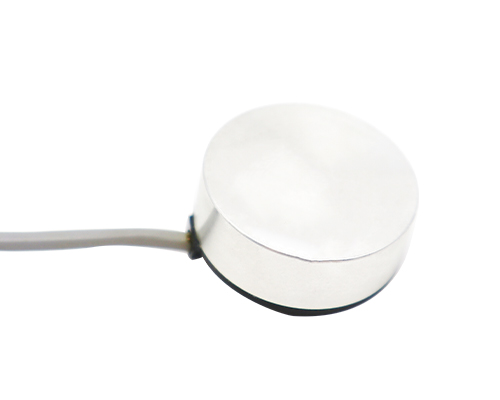
The first parameter: transmitting power
A physiotherapy transducer has one requirement: the ultrasonic power emitted must be controlled to reach "×× milliwatts."
This requires the circuit to control the transducer's emission, and then a device measures the ultrasonic power emitted by the transducer as "×× milliwatts."
The theoretical formula for instantaneous transmitting power is as follows:
Instantaneous transmitting power of transducer = transmitting voltage × transmitting voltage ÷ transducer impedance.
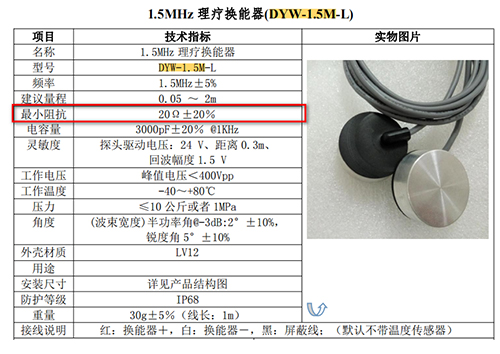
Below, using Fuzhou Dayu Electronics' model DYW-1.5M-L physiotherapy transducer as an example:
Assume the transmitting voltage is 24V and the transducer impedance is 20Ω, then
Instantaneous transmitting power = 24×24÷20=28.8W
The second parameter: duty cycle
① What is duty cycle?
Duty cycle refers to: within one pulse cycle, the proportion of time that power is on relative to the total time.
For an ultrasonic transducer, it means: within one pulse cycle period, the proportion of emission time relative to the total time.
② How is duty cycle calculated?
Take the figure below as an example to see how duty cycle is calculated:
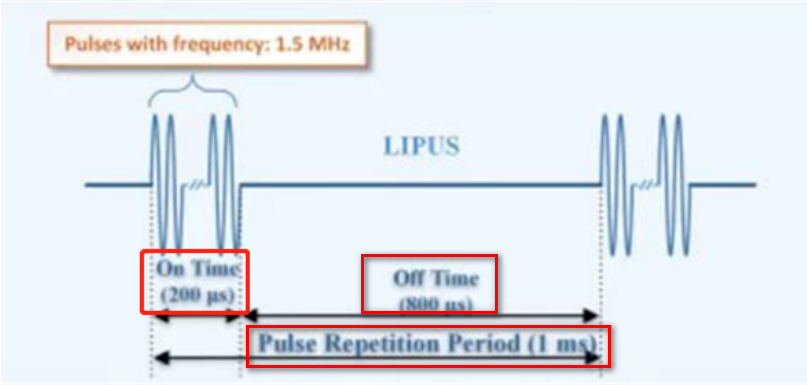
In the figure: one pulse cycle is 1ms (millisecond),
on time (emission time) is 200us (microseconds),
off time (pause time) is 800us (microseconds)
1ms (millisecond) = 1000us (microseconds)
Duty cycle = 200us ÷ 1000us * 100% = 20%
So the duty cycle is: 20%
In medical ultrasound, the duty cycle represents the operating mode of the ultrasonic wave. There are mainly two operating modes: continuous mode and pulsed mode.
Continuous mode: continuously emitting ultrasonic waves without interruption, called continuous emission.
A duty cycle of 100% is the continuous mode, meaning ultrasonic waves are emitted continuously without interruption, for example over a duration of 10 milliseconds.
Pulsed mode: take the most common duty cycle of 20% as an example; within a 10-millisecond duration, ultrasonic waves are emitted for 2 milliseconds and paused for 8 milliseconds. This operating mode is the pulsed mode.
Pulsed mode is the most common operating mode in medical ultrasound.
The third parameter: operating frequency
In physiotherapy transducers, common frequencies include: 1MHz, 1.5MHz, 2MHz, 3MHz.
In this requirement, the ultrasonic frequency is 1.5MHz. In actual use, because the transducer is placed against the human body to emit, not in water, and air is a poor conductor of heat, continuous use will cause the internal temperature of the transducer to rise.
In this case, the transducer's resonant frequency point of 1.5MHz may shift.
Another point to note: with continuous use, the transducer will heat up.
Fuzhou Dayu Electronics has been specializing in custom ultrasonic transducers for 15 years. If you also need to customize transducers or encounter challenges in transducer selection, feel free to contact us for free 1-on-1 technical consultation.