
Dayu Electronics: Technical Tips on Measuring Liquid Sound Velocity Using 2.5MHz Ultrasonic Transducers
Recently, a customer approached us with the idea of using a pair of 2.5MHz ultrasonic transducers to measure the sound velocity in different liquids—one connected to a signal generator to emit ultrasonic waves, the other connected to an oscilloscope to receive the signals, calculating the sound velocity by measuring the time difference or phase difference. The liquids planned for measurement include deionized water, saltwater of different concentrations, and alcohol of different concentrations, with the intention of directly immersing the transducers in the liquids.
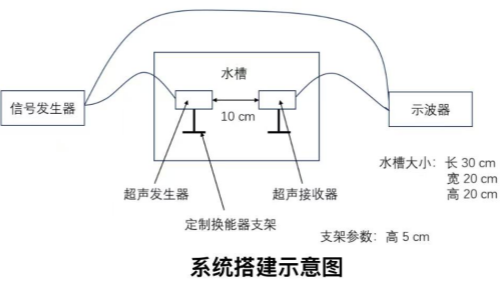
This approach is entirely feasible in principle. Since ultrasonic waves travel at different speeds in different media, accurately measuring the transmit-receive time difference can indeed allow you to derive the liquid's sound velocity, and thereby indirectly infer its concentration or composition. However, to obtain stable and accurate data in practice, there are several details that require special attention:
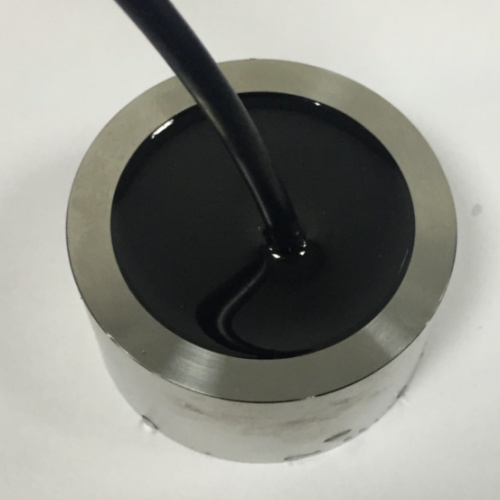
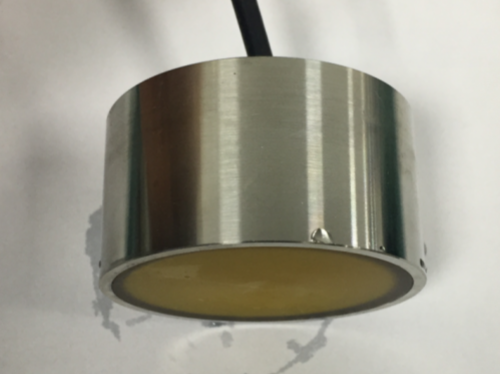
First, the waterproofing and coupling of the transducers. Standard 2.5MHz ultrasonic transducer probes are not necessarily all capable of long-term immersion. If you plan to directly immerse them in liquid, you need to confirm whether the probe surface is waterproof and whether the electrodes are properly sealed; otherwise, signal attenuation or even probe damage can occur. It is recommended to use a fixed mounting bracket to keep the two transducers coaxially aligned, ensuring that both the transmitting and receiving faces are fully submerged with no air bubbles in between—air bubbles can severely interfere with the signal.
Second, waveform identification and first-arrival interpretation. What you typically receive on the oscilloscope is a series of oscillating waveforms, and the arrival time of the first peak is the true "time difference." If you misinterpret the cycle, the calculated sound velocity will have significant errors. You can first calibrate using deionized water (sound velocity approximately 1482 m/s at 20°C) to verify that your measurement method is correct.
Third, the influence of temperature cannot be ignored. The sound velocity in saltwater and alcohol varies significantly with temperature and concentration. It is advisable to conduct tests under constant temperature conditions, or to record the liquid temperature simultaneously for subsequent correction.
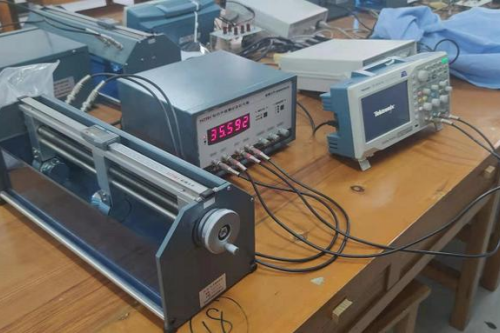
If you encounter weak signals, unstable waveforms, or abnormal readings during your experiments, please feel free to contact the technical team at Dayu Electronics. We can also recommend specialized ultrasonic transducers suitable for liquid immersion, making your experiments more convenient and your data more reliable.